


Substack built its reputation around independent writers. Journalists who left their newsrooms, essayists with stories to tell, and creators who built audiences that rival legacy media outlets.
But lately, brands are starting to slip in and do some pretty interesting things.
I’ve been tracking brands on Substack since the start of 2026, looking at data points like traffic, subscriber counts, publishing patterns, and authorship models. The entire dataset is in my full 2026 Q1 Substack Brand Report, but today I’ll share some key insights, including five standout publications that demonstrated how brands can win on Substack.
Why Substack Makes Sense for Brands
Over the past year, a growing number of companies have launched their own Substack publications. The platform now hosts more than 50 million active subscriptions, search interest just hit an all-time high, and brands are starting to notice. On other platforms, organic social reach is down, SEO traffic is volatile, and CPMs keep climbing. But on Substack, a subscriber is yours, and no algorithm decides whether your next post reaches them.
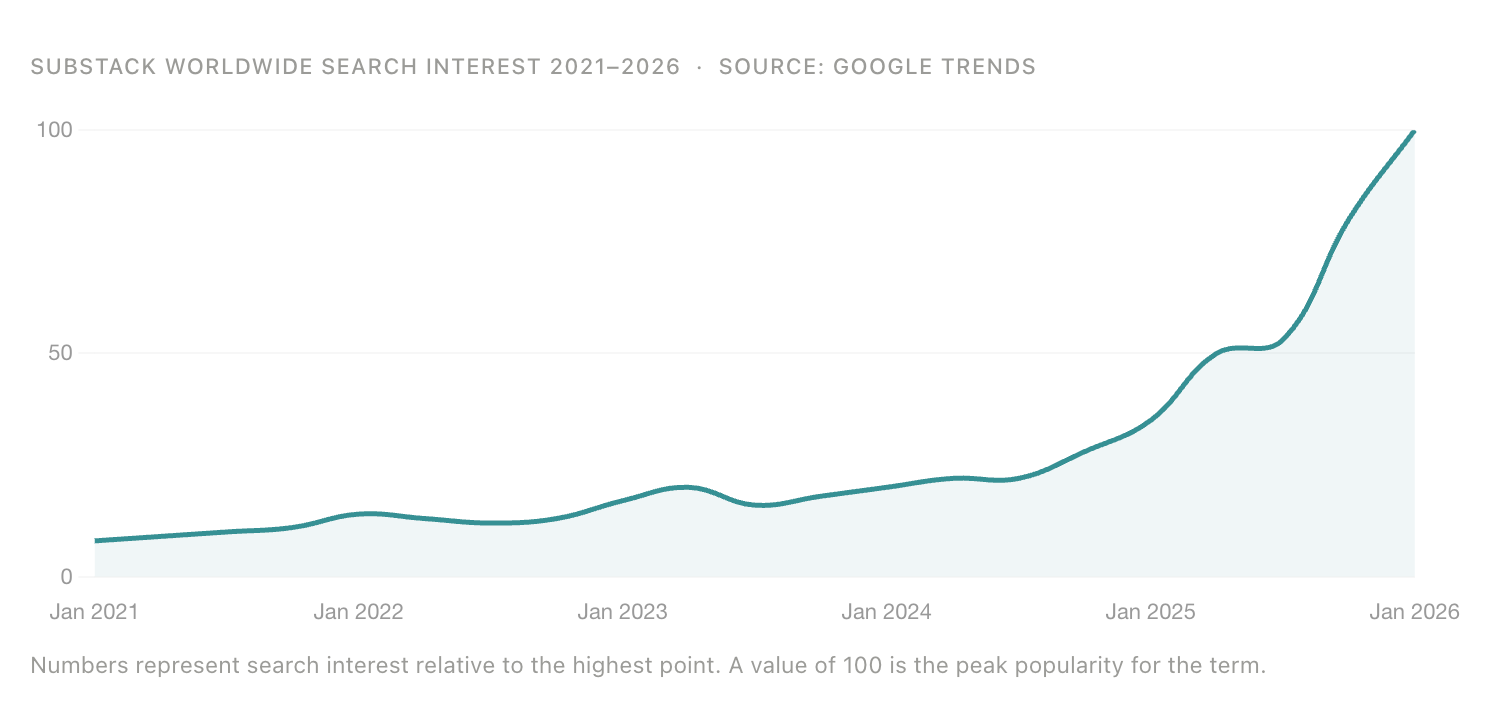
But why Substack? Why now? And is the strategy actually working for these companies?
Here’s why some brands are making the shift:
A direct line to your audience. Every post goes straight to your subscribers' inboxes. No algorithm deciding who sees it, no paying to reach people who already signed up to hear from you. For brands that have been at the mercy of platform changes for the past decade, that's a meaningful difference.
A reason to build loyalty, not just awareness. The brands doing this well use Substack community features and behind-the-scenes content that their audience actually looks forward to. A subscriber who chose to be there is a different reader than someone who stumbled across a post in a feed.
Room for a real editorial voice. Substack's format rewards substance over frequency. Brands are using it for founder stories, original data, and cultural commentary that needs more than a caption to land.
An early-mover window that won't stay open forever. Most brands still aren't on Substack, which means the ones that show up with something worth reading get more attention than they would on a saturated platform. That window will close as more brands figure this out.
Not every brand should be on Substack. It takes real editorial commitment to do this well. But for companies willing to put in the editorial work, nowhere else offers the audience-building potential that Substack does right now.
5 Brands Building a Real Audience on Substack
I’ve tracked 33 brand publications on Substack since the start of 2026 and the range is wide. Some brands have built huge audiences that rival established independent newsletters. Others have only a couple hundred subscribers and no clear strategy. These five are worth paying attention to.
1. Polymarket: The Oracle
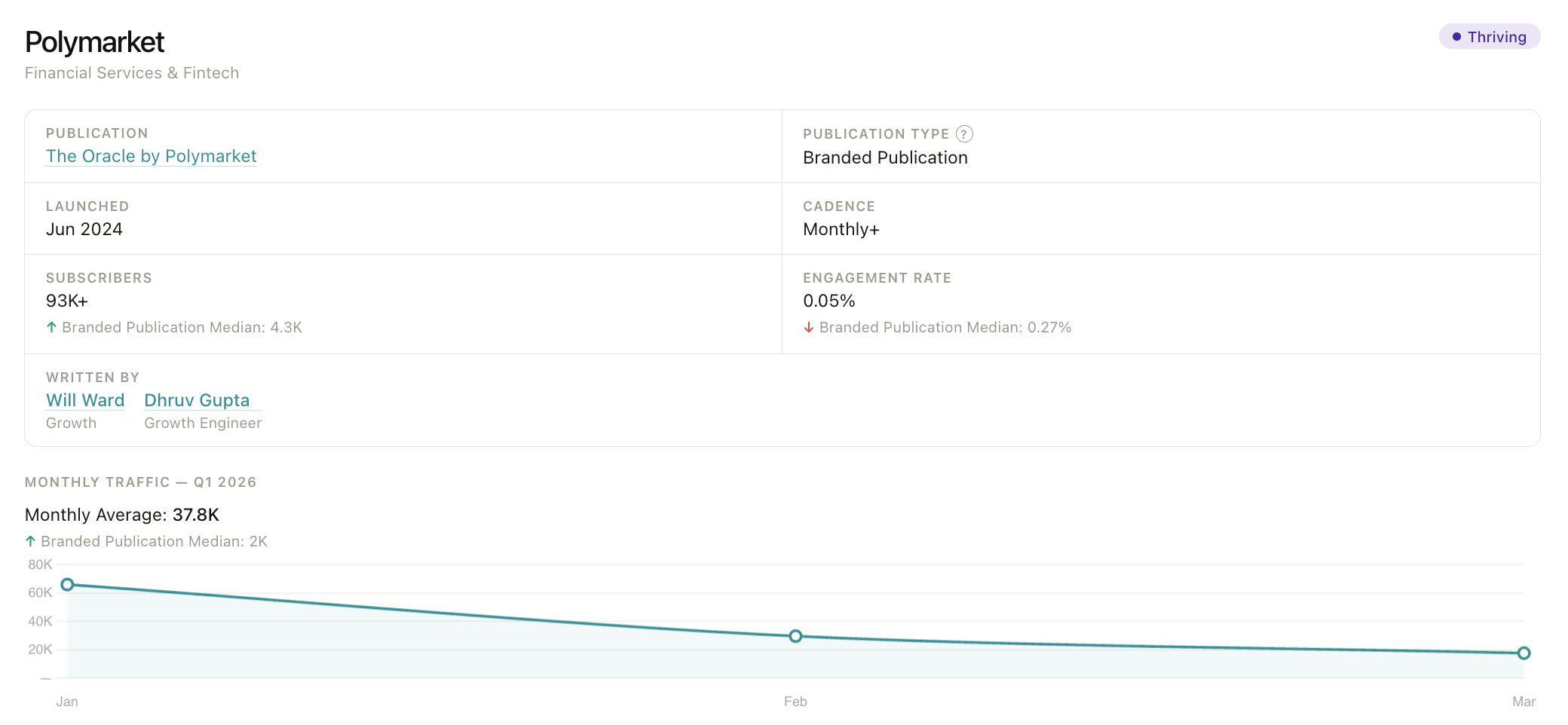
The Oracle by Polymarket is the largest brand publication by subscriber count on the platform, with 93,000 since its launch in June 2024. That number alone tends to end the conversation about whether brands can build an audience on Substack.
The Oracle publishes insights from its prediction market on a hybrid authorship model: the publication lives under the Polymarket account, but individual writers get secondary credit. Named bylines let the writers build their own reputations, while Polymarket gets a publication people actually want to subscribe to. Beyond that, Polymarket also collaborates with outside creators who have established publications and audiences of their own, which is probably the bigger driver of subscriber growth.
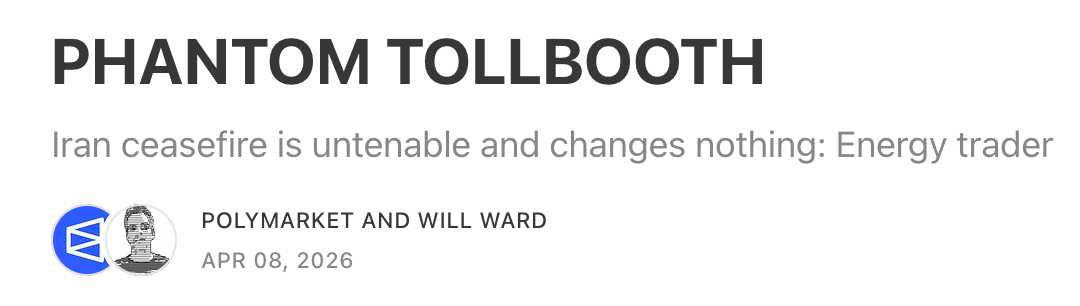
The most interesting strategic move is the formal Substack partnership, which lets any writer on the platform embed live prediction-market odds directly into their posts. That turns the entire Substack creator base into a distribution channel for Polymarket without Polymarket having to produce any of that content.
2. M.M.LaFleur: The M Dash
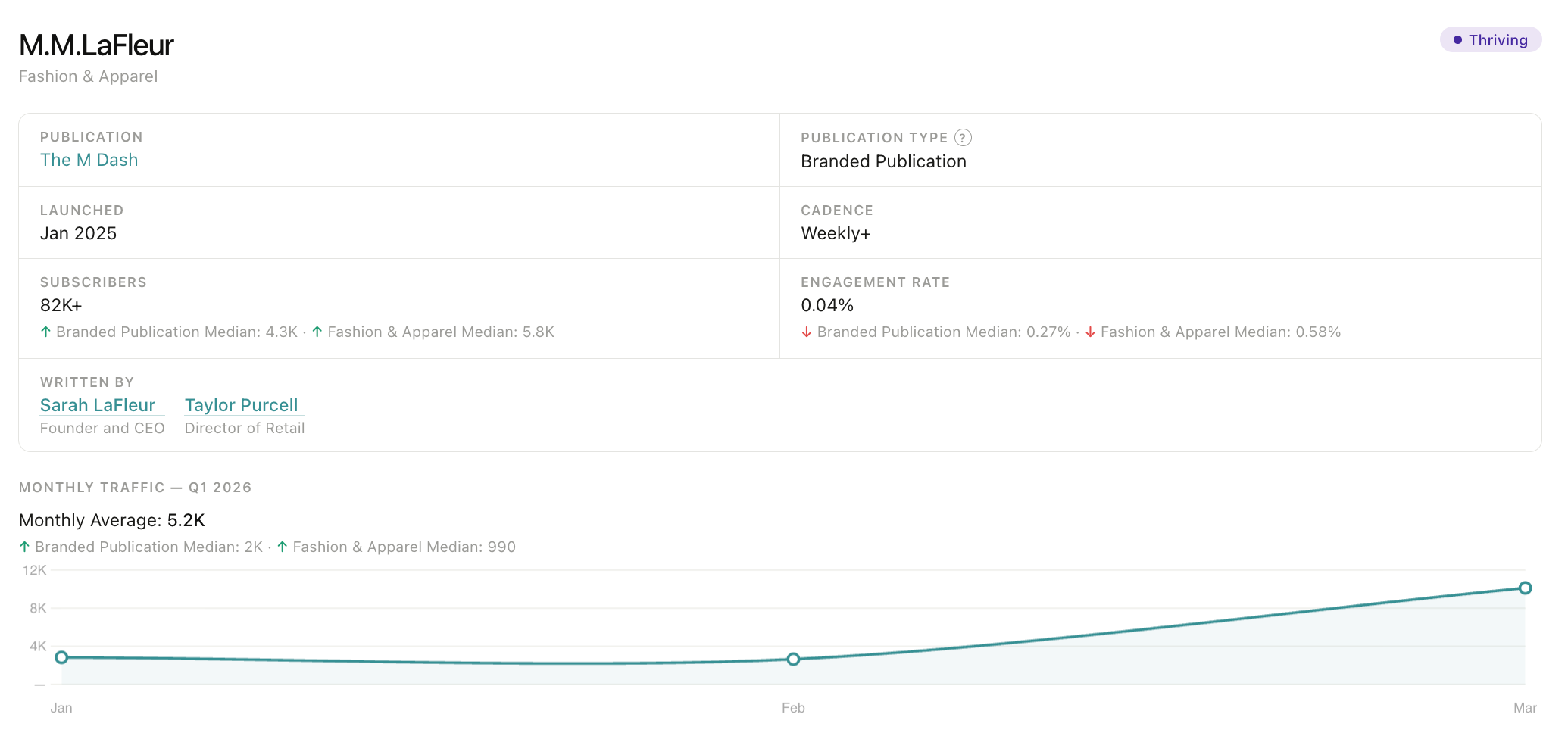
M.M.LaFleur launched The M Dash in January 2025 and reached 82,000 subscribers by Q1 2026. For context, the median number of subscribers for a branded publication in my dataset is 4,300. So either M.M.LaFleur is doing something very different, or they got very lucky.
They’re doing something different. The M Dash runs on a creator collaboration model: alongside internally written pieces, they regularly publish external contributors who have their own Substacks and their own audiences. Writers like Maayan Zilberman (Red is Best) and Alison Cheperdak (Elevate Etiquette) bring their subscribers with them when they publish in The M Dash, and M.M.LaFleur builds their list on the back of it.
The strategic lesson is that subscriber growth on Substack doesn’t have to be organic or slow. If you can publish writers who already have audiences, you can borrow distribution in a way that directly transfers subscribers, not just impressions.
3. OpenAI: The Prompt
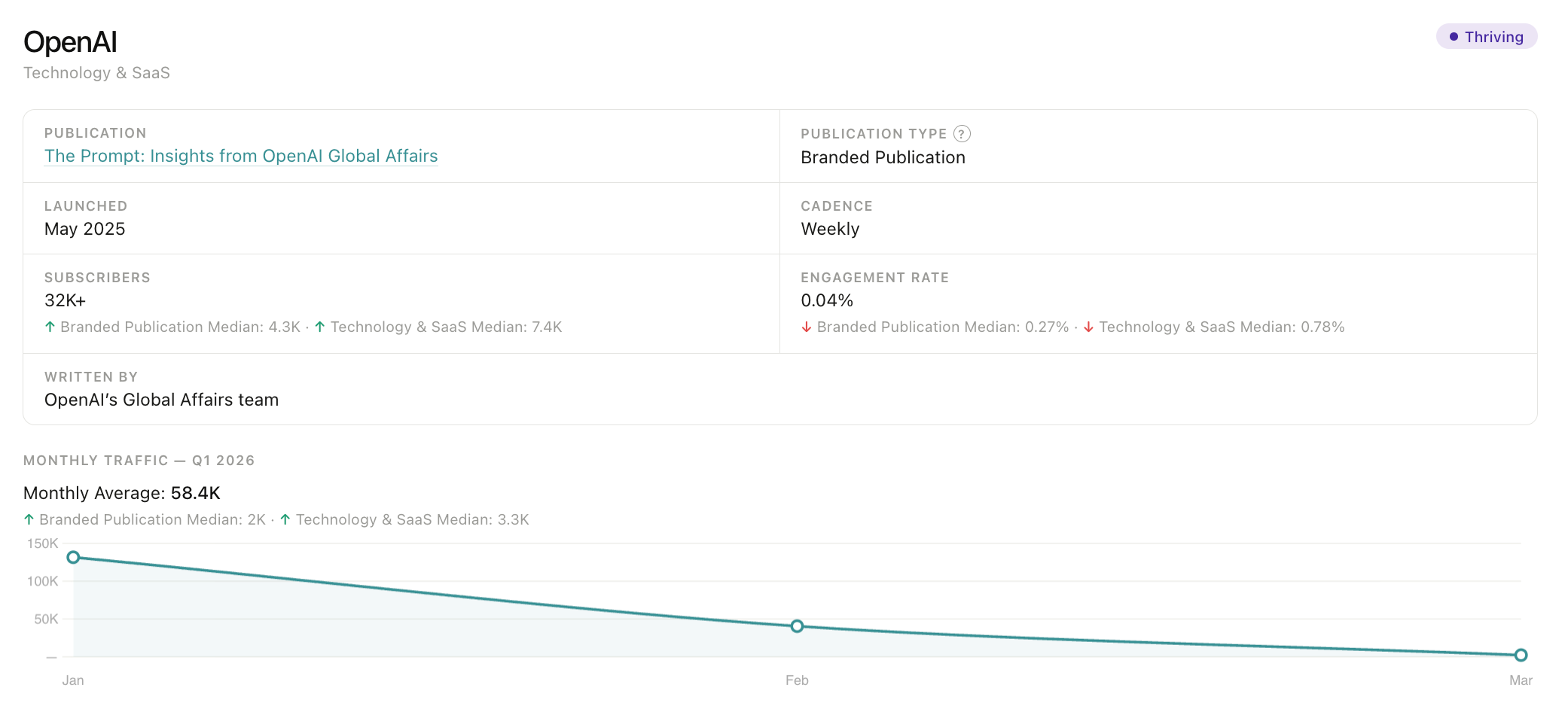
OpenAI’s The Prompt: Insights from OpenAI Global Affairs doesn’t come from their marketing team. It comes from the Global Affairs team, and it has a very specific audience in mind: DC policymakers, journalists covering AI and regulation, and people who want to understand what OpenAI thinks about governance.
That narrow mandate explains why it works so well with 32,000 subscribers and an average of 58,400 monthly visits in Q1 2026. Most people ignore topics like the Stargate announcement, AI governance frameworks, and state-level AI policy. But for the people who are interested, there’s almost nowhere else to get OpenAI’s actual thinking on these questions.
Brands often try to be interesting to everyone and end up being interesting to no one. OpenAI took a different path and built a publication that’s essential to the people who influence where AI policy goes next.
4. Shopify: In Stock
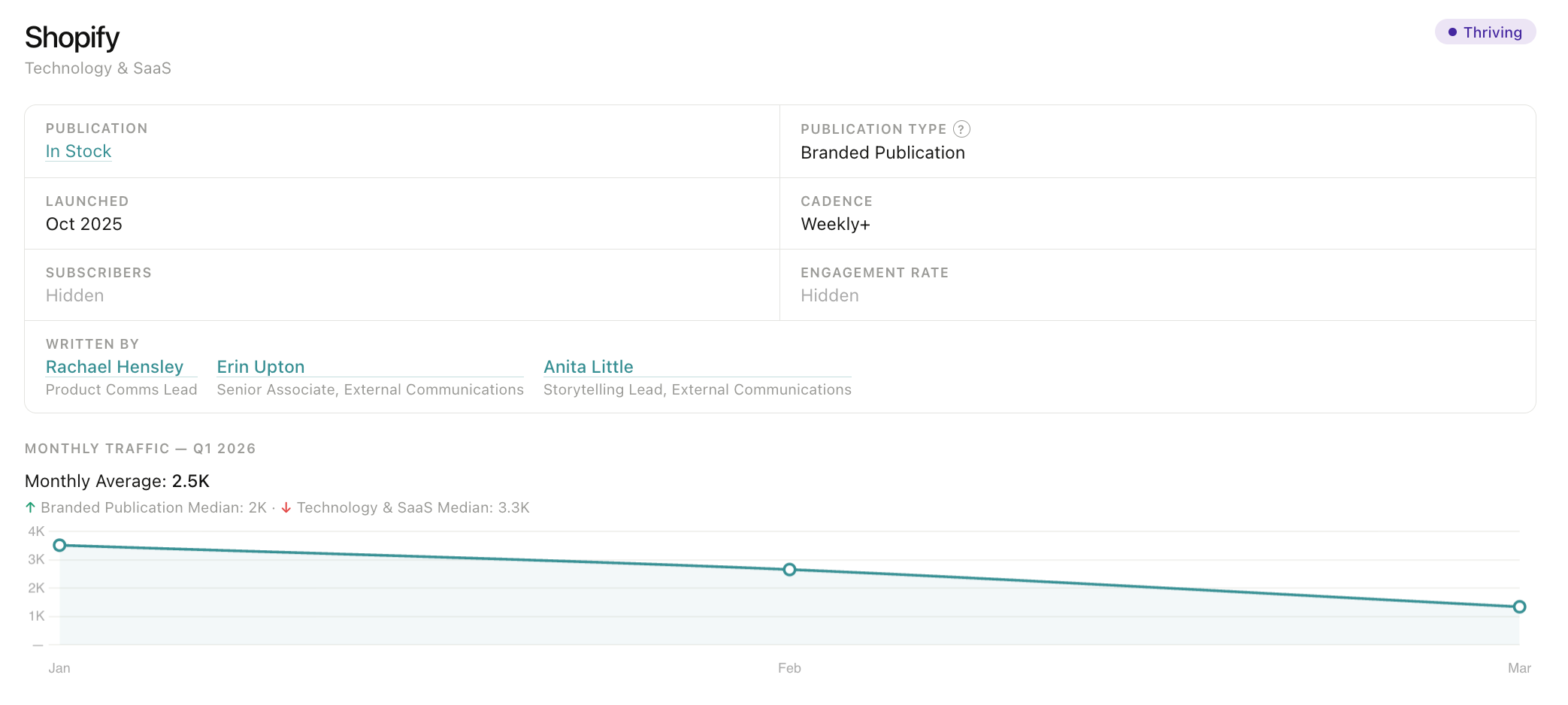
Shopify’s In Stock launched in October 2025 and was already drawing around 14,000 monthly visitors by Q1 2026. Six months is a short runway to build traffic, and the explanation is straightforward: three named internal writers share the publishing load at a weekly-plus cadence, which means the publication actually shows up consistently, and Shopify has access to material no outside creator could replicate.
In Stock’s content includes first-person accounts from merchants building a business on the Shopify platform and commerce trend thinkpieces that draw on transaction data from millions of stores. Shopify is translating access into stories.
Companies traditionally show up online under their brand name rather than employees, but that model creates a disadvantage on Substack. In my dataset, publications with named writers in the byline consistently outperform those that publish under the brand name alone.
5. Blackbird: The Supersonic
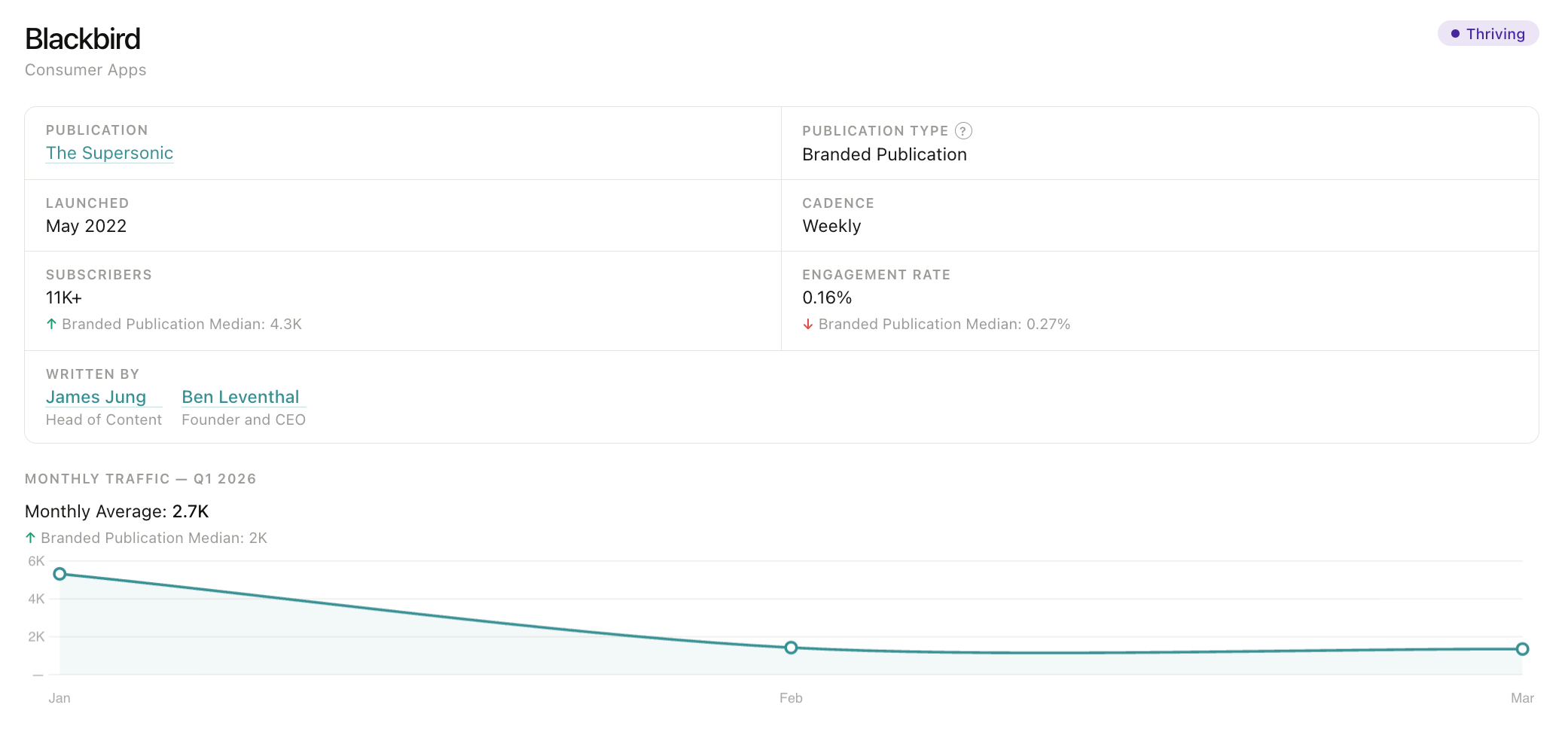
Blackbird is a restaurant loyalty platform that most people probably haven’t heard of, but The Supersonic: Blackbird's Secret Substack, which has been publishing since May 2022, has 11,000 subscribers.
The writing covers restaurant culture: profiles of restaurateurs, essays about dining, and lists that are actually useful. It reads like journalism because that’s what it is.
The Supersonic matters here because the branded Substack model doesn’t require a massive platform or a big distribution budget to work. Four years in, a brand most people haven't heard of has built an 11,000-person audience highly relevant to their product by publishing consistently and taking the editorial seriously.
Q1 2026 Substack Brand Report
The full Q1 2026 Substack Brand Report covers all 33 publications I tracked, with traffic data, subscriber counts, publishing patterns, and authorship models for each. If you want the complete picture, you can access it here.
To endless possibilities,
Casandra
PS. Know about any brands on Substack that I missed? I’d love to check them out, too! Leave a comment or DM me!
Looking to bring your brand to Substack?
Whether you’re still deciding or ready to build, I’ll meet you where you are.
I offer executive briefings and hands-on strategy sessions for marketing teams that want to win on Substack.
I noticed that @protonprivacy launched on Substack recently and their subscriber count is growing quite fast.