


Are you stuck playing the content lottery?
You pour hours into a post you love, and it gets...nothing. You whip up a quick idea, and it goes viral. The inconsistency is exhausting, and it feels like you’re constantly guessing what the algorithm wants.
Everyone’s trying to beat the algorithm. But the truth is, the only way to beat it is to become one.
Social platforms learn by running thousands of tiny experiments. They show one type of post to a small group, measure how people react, and then adjust what they show next. Over time, the algorithm that governs this testing learns what keeps attention and what doesn’t. The posts that perform get pushed to more people. The ones that flop disappear quietly into the feed.
The algorithm gets smarter by continuously testing, learning, doubling down, and repeating.
Creators should be doing the exact same thing. If you want consistent growth online, stop guessing what the algorithm wants and start thinking like one in three steps: explore, measure, exploit.
This approach is known as the exploration–exploitation dilemma,1 and it’s one of the simplest yet most powerful algorithms in existence. It’s how Netflix recommends what you’ll watch next,2 how scientists develop drug dosing protocols,3 and how you can systematically find the ideas your audience loves.
In this article, I’ll show you how to use the exploration–exploitation dilemma to grow your audience, refine your creative instincts, and stop wasting time on content that goes nowhere.
What Most Creators Get Wrong About Content Strategy
Creators talk about “beating the algorithm” like it’s an enemy to outsmart. But the real problem isn’t the algorithm; it’s how we behave in relation to it.
Algorithms are ruthlessly consistent. They test millions of variations, track performance objectively, and pivot instantly when something stops working. Humans… not so much.
Most of us do the opposite:
We post randomly, chasing novelty instead of building a feedback loop.
We get attached to ideas that underperform.
We ignore data until we’re frustrated by stagnation.
We cling to what used to work, even after the platform has moved on.
The algorithm isn't smarter than you. But it is more disciplined, and it never stops testing.
If you want consistent growth, you have to start treating your content like a series of small experiments, not creative lottery tickets.
You don’t need a PhD in data science to do this. You just need a lightweight version of the algorithm’s playbook: a simple system for exploring ideas, measuring results, and exploiting the winners.
The Explore–Exploit Framework
Every algorithm faces a constant tradeoff. Does it explore something new that might perform better? Or does it exploit what’s already proven to work?
That's the explore-exploit dilemma: the balance between curiosity and efficiency, between testing and scaling.
In practice, algorithms solve this by running continuous experiments. They try new ideas in small batches (exploration), measure which ones get traction, and then go all-in on the winners (exploitation).
That’s how Netflix tests thousands of thumbnail images to see which one makes you click,4 and how scientists use AI to decide which chemical compound to test next in drug discovery.5
This isn’t about perfection. Algorithms don’t care if most tests fail; they care about how quickly they can identify what works.
Creators can use the exact same approach. Instead of guessing what your audience will love, you can design your own feedback loop:
Explore: Publish a wide variety of small, fast experiments.
Measure: Watch what people actually engage with.
Exploit: Double down on the ideas, formats, and hooks that hit.
Then you repeat…forever. Over time, you’re not just making content, you’re training your own algorithm: a personalized system that learns what works for your audience faster than intuition alone ever could.
Successful Creators Already Know This
If you look closely at the feeds of the biggest creators, you’ll see this pattern everywhere.
When something takes off (a format, a tone, a hook, even a camera angle), they repeat it. Not because they’ve run out of ideas, but because they’ve found a signal worth exploiting.
Once a post format hits, they’ll remix it ten different ways. For example, they keep the story and swap the hook, keep the format and change the topic, or keep the tone and shift the angle.
They take a proven creative pattern and scale it. They’re running the same algorithmic logic as the platforms themselves: test broadly, identify what hits, then feed the system more of it until the returns fade.
What looks like “consistency” from the outside is actually iterative exploitation: a deliberate scaling of proven creative patterns.
That’s what separates creators who grow steadily from those who burn out chasing novelty.
Check out this photo from an Instagram feed. The reel in the middle has 2–3 times more views than most of the other reels in this photo.
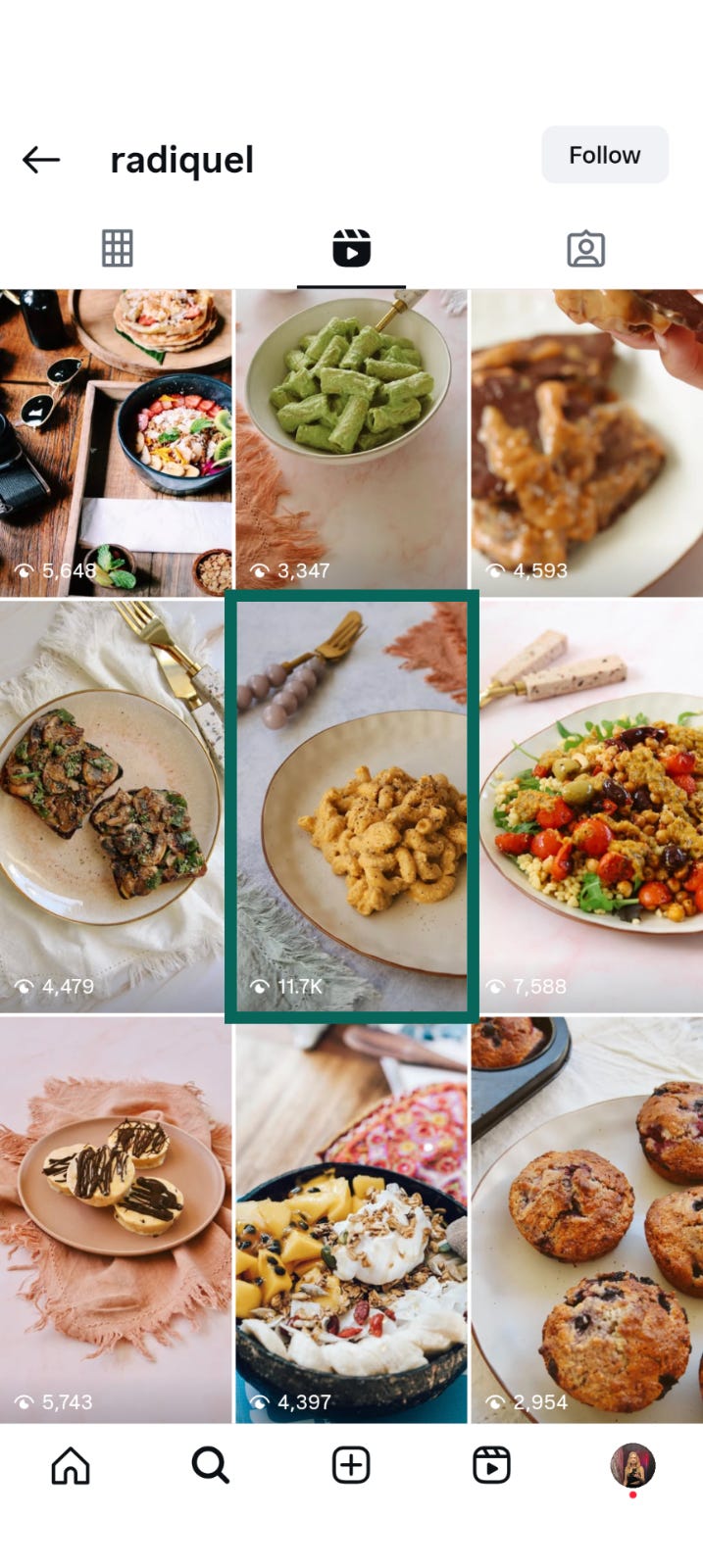
In that reel, the creator, a vegan nutritionist, shares what she eats in a day, with a focus on protein.
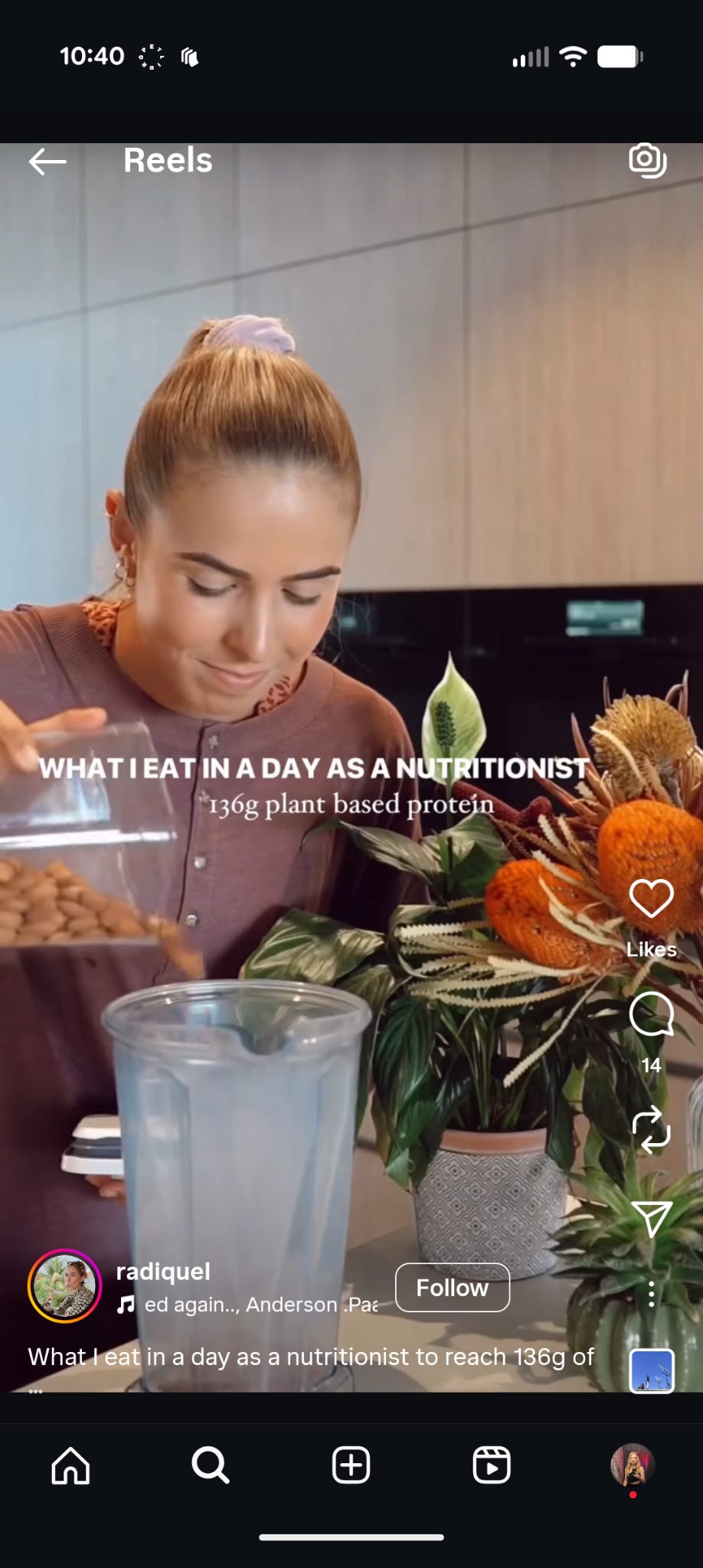
But this isn’t the first time she posted a reel with this format. She has clearly noticed that this format works well with her audience because she has been repeating it about once a week for several years. Her winning pattern is a high-protein vegan 'day in the life' that combines a format and a topic. If we could see her data, I'd bet a sizable share of her audience growth traces back to these reels.
The Explore → Exploit Content Strategy
So how do you actually do this? How do you build your own lightweight version of the algorithm, one that helps you identify what works, scale it, and keep learning without burning out?
Here’s a simple, repeatable framework you can start using this week.
1. Explore: Run Small, Fast Experiments
Treat your content like a lab. Start with lots of low-effort, high-variation tests. Exploration posts should take no more than 30 minutes to create. The goal is speed and volume, not polish.
Think of this as feeding data to your future self by running tests across different variables:
Hooks: Test 3 different first sentences/visuals for the same idea (e.g., A question vs. a shocking statement vs. a command).
Topics: Test an adjacent topic you haven’t covered yet (e.g., If you cover finance, test a post on productivity).
Formats: Try an image carousel instead of a short video, or a listicle instead of a narrative.
Tone: Try a post that is slightly more aggressive/opinionated, or one that is more empathetic/instructional.
If you’re posting five times a week, make three of those pure exploration, something new in format, structure, or theme.
Claude Hooks Skill: Get a Set of Different Hook Options in Seconds
The hardest part of the explore phase is writing three hooks that are genuinely different, not three versions of the same one.
That’s why I built the Claude Hooks Skill for Really Good Business Ideas Premium members.
Paste your topic into Claude, and it drafts a batch of hooks built on different proven patterns (a contrarian take, a curiosity gap, a numbered promise, a personal angle, and more), so every test pulls a different lever. It draws on 200 proven hook templates across 10 categories, so the options are never cookie-cutter.
To use it, all you need to do is add the Really Good Business Ideas Connector to Claude, then start a chat and type something like “Write me five hooks to test for a reel about a 10-minute high-protein breakfast,” or “Give me a batch of hooks for a Substack note about the book that changed how I handle anxiety,” or “I need hooks for a TikTok about packing for a two-week trip in a carry-on.”
2. Measure: Track The Results
Pay attention to which posts get above-average distribution. You’ll know because they reach more people and earn more engagement than the rest of your content.
But don’t just chase numbers. As long as that engagement is coming from the right people (the audience you actually want), you’ve found a winner. If it’s coming from the wrong crowd, you may have strayed too far off-topic, and it’s not worth repeating.
Focus on Leading Indicators of Audience Quality:
High Save/Share Rate: This signals utility and permanence. The audience finds it useful enough to keep or forward.
Comment Quality: Are the comments deep, specific questions, or just emoji reactions? High-quality comments suggest an engaged audience.
Read/Watch Time from Subscribers/Followers: If your existing audience is consuming the post fully, it confirms you’ve hit a core need.
3. Refine: Identify the Pattern
When something performs well, don’t just repeat it blindly; get curious about why. Run a quick deconstruction process to see what holds up:
Theme/Topic: What core problem did this solve?
Format: What was the structure? For example, A What I Eat in a Day vs. The 5 Biggest Mistakes list.
Hook: What were the first 3 seconds (or first sentence) that stopped the scroll?
Pacing/Tone: Was it fast-paced, serious, or humorous?
Make a quick hypothesis about what made it hit, then run a few targeted experiments to see if you can replicate the results. Keep what holds up, discard what doesn’t.
Over time, you’ll start to see patterns that reliably attract your ideal audience. That’s how you move from guessing to understanding what works.
Claude Hooks Skill: Analyze Winning Hooks and Find the Pattern
When a post takes off, it's easy to celebrate and hard to repeat. The thing that actually made it work, the hook, usually goes unexamined, so next time you're guessing all over again.
That’s why I built the Claude Hooks Skill for Really Good Business Ideas Premium members.
The same Claude Hook Skill that writes hooks can also analyze them. Paste in a hook that performed, and it names the levers and the proven pattern behind it, then hands you the repeatable pattern you can use again. Paste several of your winners, and it finds the recipe they share, the combination your audience reliably responds to.
You already know which posts worked. This tool will show you how to do it again.
To use it, all you need to do is add the Really Good Business Ideas Connector to Claude, then start a chat and type something like “Here's a hook from my best-performing reel. Break down why it works and give me five more like it,” or “Here are my five top-performing Substack notes. What do they have in common?”
4. Exploit: Double Down on Winners
Once you understand the winning pattern, repeat it regularly. This could mean covering the same topic from different angles, using the same content structure to cover different topics, or even just using the same hook format or visual aesthetic. You’ll know what the winning piece is from your previous experiments.
Ride the wave while it’s strong, but keep an eye on the data. When engagement starts to dip, it’s time to increase your exploration again.
5. Rebalance: Keep the Loop Alive
The biggest trap of success is getting stuck in what used to work. Once you’ve found a few winning formulas, keep most of your energy there, but reserve the rest for new experiments. That ongoing exploration is what keeps you evolving with the platform and ahead of audience fatigue.
Every few weeks, zoom out and reassess. Which experiments hit? Which winners are losing steam? Adjust your mix, refresh your hypotheses, and start another round. That’s how you stay in motion, not by reinventing your entire strategy, but by constantly learning, testing, and rebalancing just like the algorithms do.
6. Expand: Bring Winning Patterns to New Platforms
When something works, don’t assume it only works there. A strong idea can and should travel. If a post hits on one platform, use it as a signal to test the same concept elsewhere:
A post that pops on Threads can become a tweet on X and a carousel on LinkedIn.
A short that takes off on YouTube can become a Reel or TikTok.
A newsletter that receives a lot of engagement can be transformed into an Instagram carousel.
Each platform has its own culture and format, but the underlying psychology of curiosity and novelty stays the same. Think of it as scaling what works by adapting it to new contexts. That’s how great ideas stop being “content” and start becoming systems: repeatable, flexible, and built to travel.

The best creators aren’t magicians. They're disciplined scientists who run a systematic machine of testing and scaling. When you adopt the explore-exploit strategy, you stop playing the lottery and start engineering predictable growth. It’s time to stop guessing and start building your own algorithm for success.
To endless possibilities,
Casandra
Need More Help?
Really Good Business Ideas Premium: A membership designed to make starting and growing a profitable business easier. Full archive access, DM support, and a library of tools and resources.
Substack Creator OS: A complete operating system for planning, writing, growing, and monetizing your newsletter, all in one connected Notion workspace. (Right now, it’s free for Premium subscribers.)
Work With Me Directly: Book a 1-on-1 consultation or coaching call to get personalized help when you need it. Think of it as a focused working session to get unstuck, gain clarity, or move something forward.
Build Your Brand on Substack: Whether you’re still deciding or ready to build, I’ll meet you where you are. I offer executive briefings and hands-on strategy sessions for marketing teams that want to win on Substack.
Great article. Learned many things that I’m going to explore deeper in Substack.
This was a great reminder to keep experimenting! I was curious to read more about how Netflix uses this framework but when I followed your source (5 Things We Have Learned From Continuous Explore Exploit Applications at Netflix) there was only an intro paragraph and no content. I did find a video of the same presentation here: https://hyperight.com/5-learnings-from-continuous-explore-exploit-applications-at-netflix-sophia-liu-netflix/ Hope this helps!