


Is Substack free?
It’s one of those questions that sounds simple…until you actually try to answer it.
Yes, you can read Substack newsletters for free. Yes, you can start writing on Substack without pulling out a credit card.
And yet, almost everyone who spends real time on the platform eventually runs into tradeoffs and fees that don’t feel free at all!
Substack is built to turn attention into financial support.
For readers, that means managing a growing number of paid subscriptions.
For writers, it means balancing zero upfront costs with revenue shares, platform incentives, and optional (but often necessary) upgrades as you grow.
This guide covers both. We’ll take a closer look at what’s actually free on Substack, what costs money, and how those costs differ depending on whether you’re reading, writing, or trying to build a real business on the platform.
Table of Contents
Is Substack Free for Readers?
The Substack website and app are both free for readers, but the platform is designed to move you from browser to supporter. It does so by making it easy for publications to offer paid subscriptions that include paid perks like deeper content access and community engagement.
While many publications are always free, the platform’s primary goal is to help writers monetize their work, so paid subscriptions are the backbone of the ecosystem. Because Substack is a platform of individuals rather than a single aggregator (like Medium), you subscribe to each writer separately.
Substack Publication Subscription Fees
Substack sets a minimum price of $5/month (before any special promotions), making this the standard entry price for almost any paid publication.
Unlike Medium, where one fee unlocks everything, or Patreon, where creators can set $1 tiers, Substack doesn’t offer a platform-wide subscription or an option to "tip" a small amount for a single article.

This structure means costs can quickly add up for the curious reader. Supporting just five of your favorite writers at the minimum tier totals $25/month (quite a bit more than a standard Netflix subscription).
For this reason, most readers are selective, supporting only the publications they find uniquely valuable within specific interests. Unlike a massive streaming service, your subscription fee is a direct investment in a specific creator's livelihood.
The App Tax: Why You Should Avoid Subscribing in the Mobile App
If you are using the Substack iOS or Android app, you are likely seeing prices higher than the writer originally set. This is because the app stores require a 15–30% commission on all purchases.
In August 2025, Substack introduced adjusted pricing to protect writer margins. By default, Substack automatically inflates subscription prices inside the mobile app to cover the store’s commission, essentially passing the “app tax” directly to the reader so the creator doesn’t lose any money. (Writers can opt out if they’re willing to absorb the cost themselves.)
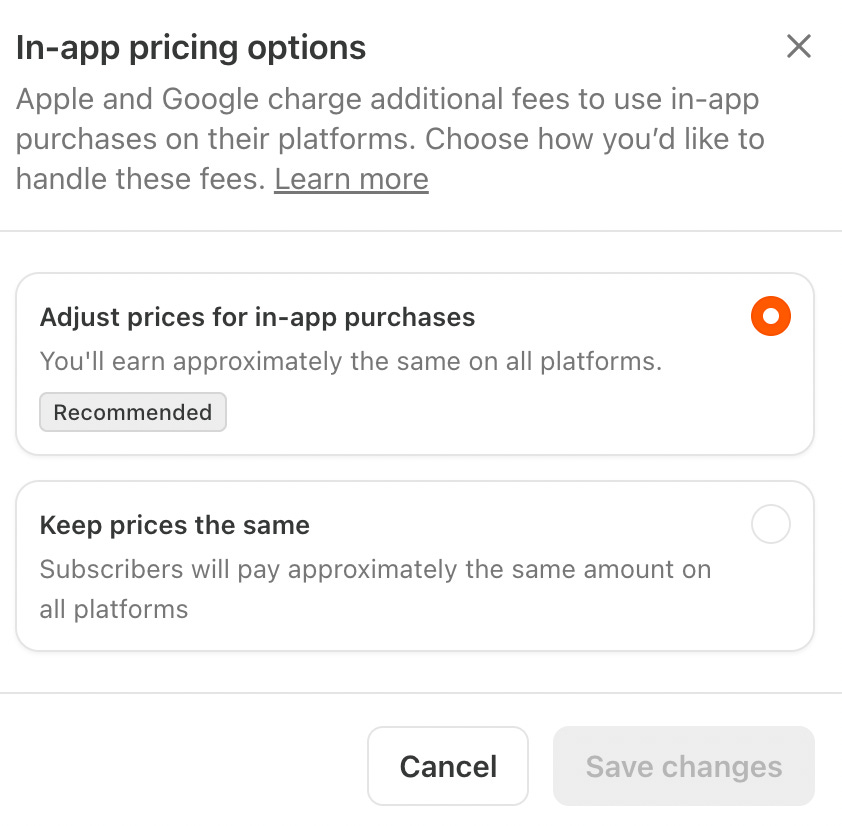
Here’s an example from Substack on how a publication’s price might be inflated.
Click here to open the table in a new tab.
How to Avoid the App Store Tax
You aren’t locked into these higher app prices. Because Substack allows for multi-platform access, you can use a simple workaround:
Browse on the App: Find the publications you love and want to subscribe to.
Subscribe on the Web: Instead of hitting “Subscribe” in the app, open your mobile browser (like Safari or Chrome), go to the writer’s Substack URL, and pay there.
Unlock the App: Once you’ve paid the lower web price, your account will instantly unlock the paid perks back in the app.
Bonus: It’s also much easier to manage your billing on the website. Subscriptions bought through the app are managed by Apple or Google, making it much harder for the publication to help you with refunds, discounts, or billing issues.
The Hidden Savings: Privacy and Focus
Although subscription costs can add up, the primary “cost” you save as a Substack reader is your privacy and focus. Unlike most social media platforms, Substack is almost entirely devoid of:
Display Ads: Your reading isn’t interrupted by flashing lights or pop-ups.
Data Mining: Substack’s business model is based on subscriptions, not auctioning your attention to advertisers. Even as a free reader, you aren’t being targeted by brands the way you are on most content platforms.
Is Substack Free for Writers?
Substack is free for writers as long as you don’t charge your readers. In fact, it’s one of the only email platforms that allows you to build an audience of infinite size without ever charging you a monthly hosting fee. However, the real cost changes the moment you decide to turn your hobby into a business. Once you begin charging a paid subscription fee to your publication, Substack becomes a percentage-based partner.
Which Substack Features Are Always Free?
If you never intend to charge your readers, Substack is 100% free. Unlike competitors like Mailchimp or Kit, which charge you more as your subscriber count grows, Substack provides the following at no cost:
Unlimited Subscribers: Whether you have 10 or 100,000 readers, your bill is $0.
Unlimited Content: There are no caps on how many newsletters, podcasts, or videos you can publish.
The Growth Network: You get free access to Substack Notes (their social feed) and the Recommendations engine, which Substack claims drives over 25% of all paid subscriptions on the platform.1
The Cost of Success on Substack
Substack’s business model is a bit like a partnership rather than a subscription. The more successful you are, the more you pay. When you turn on paid subscriptions, the free model ends, and the fees begin.
In 2025, a writer typically loses about 13% to 15% of their gross revenue before the money hits their bank account:
Substack’s Cut: A flat 10% commission on every transaction.
Stripe Processing Fee: 2.9% + $0.30 per transaction.
Stripe Billing Fee: An additional 0.7% for recurring subscriptions (for accounts created after July 2024).
The Math: If a reader pays you $5.00, you don’t get $5.00. After Substack takes $0.50 and Stripe takes roughly $0.45 in processing and billing fees, you take home $4.05.
It is the best deal on the internet for beginners and hobbyists, but it becomes the most expensive software you use once you reach high-scale success.

Custom Domain One-Time Fee
While starting a Substack costs nothing, professionalizing your web address does. By default, your publication lives at a URL like yourname.substack.com. If you want a cleaner look like www.yourname.com, you’ll have to pay for it.
Substack charges a one-time $50 USD fee to link a custom domain. It’s important to remember that this $50 only covers the “connection” between Substack and your domain; it does not include the cost of actually buying the domain name. You’ll still need to pay a separate registrar (I use Namecheap) about $10–$20 per year to maintain ownership of the domain name.
Why I Recommend Custom Domains
Portability: If you ever decide to leave Substack for another platform, your readers and your backlinks (crucial for SEO) follow your domain, not Substack’s.
Branding: A custom domain helps you stand out and makes you look more like a standalone media brand.
Social Sharing: Custom links are often easier to share on social media platforms that sometimes suppress or shadow-ban standard
substack.comlinks.

When Free Becomes The Most Expensive Option
Looking at the table below, you can see a clear tipping point around $2K in monthly revenue.
Under $2K/mo: Substack is the better financial deal compared to competitors because your 10% fee is less than the typical monthly bill for email newsletter software.
Over $2K/mo: “Free” officially becomes more expensive than the paid competitors. At this stage, some writers often consider moving to a flat-fee platform to save that 10% and reinvest it into their business.
Click here to open the table in a new tab.
Note: The exact costs you would pay on each platform depend on your total subscriber count and revenue. If you have a very large, undermonetized list, Substack could be the more affordable option. But if you have a smaller list with a high paid conversion rate, Substack would quickly become the most expensive option.
Why Pay the 10% at All?
If Substack is more expensive for successful writers, why do they stay? For many, the 10% is seen as a marketing fee rather than a software fee. Substack’s business model creates a direct alignment between the platform and the creator: Substack only makes money when you do.
Because they don’t charge upfront fees or monthly hosting costs, their primary revenue comes from a 10% commission on your paid subscriptions. This creates an incentive for Substack to build growth tools (like the Recommendations engine and Notes) specifically designed to help you find and convert readers. Unlike traditional ad-based media, which rewards viral clicks, this model focuses on long-term value and trust between you and your audience. When your publication thrives, the platform thrives, ensuring its development efforts remain focused on your bottom line.
So, Is Substack Free?
The honest answer is that Substack is free to start, but expensive to scale. Whether you are a reader or a writer, the "free" experience is a gateway into a much larger ecosystem.
For readers, Substack is free to browse, and you can follow any number of publications in an ad-free environment where you can read public posts without a platform-wide subscription fee. However, many publications monetize with paid subscriptions in exchange for deeper content access, community access, and other perks.
For writers, Substack is free to start, offering a “success tax” model that charges nothing for hosting but takes a significant cut of your earnings. While you can have an unlimited audience of free readers and use email, website, podcasting, and video tools for $0, turning on paid subscriptions triggers a 10% platform fee on all subscription revenue.
To endless possibilities,
Casandra
🎁 Premium Bonus: Substack Revenue Calculator
Not sure what to charge or how much you’ll actually keep?
This Substack Revenue Calculator helps you estimate your subscription earnings based on subscriber count, pricing tiers, and platform fees. See how different price points would affect your revenue, compare monthly vs. annual plans, and see exactly what you take home after Substack and Stripe fees.