


Most people set goals that are just big enough to feel responsible, but not big enough to actually change anything. We pick targets we’re pretty sure we can hit, because staying inside our current identity feels safer than stretching into a new one.
But here’s the irony: Small goals rarely change your life. Big goals almost always do, even when you miss them.
Big, hairy, audacious goals demand new behaviors, tighter systems, better boundaries, and a different version of you. That’s why they produce outsized improvements. The size of the goal determines the size of the transformation.
If you want a year of real growth, the kind that shows up in your work, your habits, your confidence, and your results, you don’t need more discipline. You need a goal big enough to demand change.
What Is a Big Hairy Audacious Goal (BHAG)?
The term Big Hairy Audacious Goal (BHAG) was coined by Jim Collins and Jerry Porras in Built to Last to describe a long-term, ambitious, and energizing target that’s bold enough to stretch an organization’s identity and change the trajectory of what’s possible.
A BHAG is not just a “big goal.” It has a specific psychological profile:
1. It’s clear and compelling: A BHAG is unambiguous. It doesn’t require a strategy document to understand. You can say it in one sentence, and anyone instantly knows what you mean.
2. It feels beyond your current capacity: A true BHAG sits outside your comfort zone. It’s difficult enough that you don’t yet know exactly how you’ll achieve it, but it's still achievable with sustained commitment.
3. It reshapes how you think and behave: The defining feature of a BHAG is that it forces identity expansion. You cannot hit it by staying who you are today; you have to operate at a higher standard, become more resilient, and adopt better systems.
4. It creates long-term focus: BHAGs are not quick wins. They’re the north star that guides priorities, decisions, and daily habits over a long horizon.
5. It inspires action. The goal is audacious enough to spark energy. It gives you something meaningful to pursue, something that creates momentum simply by existing.
A BHAG is not a vague fantasy or a wish like “double my subscribers someday.” It’s concrete, specific, and intentionally bold.
“Reach 100,000 subscribers within five years.”
“Build a seven-figure media business from a single-person operation.”
“Help 1,000 corporate employees transition to full-time self-employment by 2030.”
“Become the Michelin Guide of the software industry (the undisputed standard for quality ratings).”
“Operate a business that runs fully autonomously for three consecutive months while the founder is offline.”
“Write a book that hits the New York Times Bestseller list and stays there for 4 weeks.”
The point of a BHAG isn’t just achieving it, it’s who you become in the pursuit of it.
The Science Behind How Big Goals Transform Performance
Most people think big goals work because they’re motivating, but the real reason they work is more profound and much more interesting.
Big goals don’t just change what you’re aiming for; they change how you aim.
How your brain allocates attention, how your nervous system manages intensity, and the identity you begin operating from.
1. Big Goals Trigger High-Performance Focus

Decades of work by organizational psychologists Edwin Locke & Gary Latham (the pioneers of goal-setting theory) show that difficult, specific goals consistently outperform easy ones.1
Locke and Latham found a linear relationship between goal difficulty and performance. Performance increases as the goal's difficulty increases.
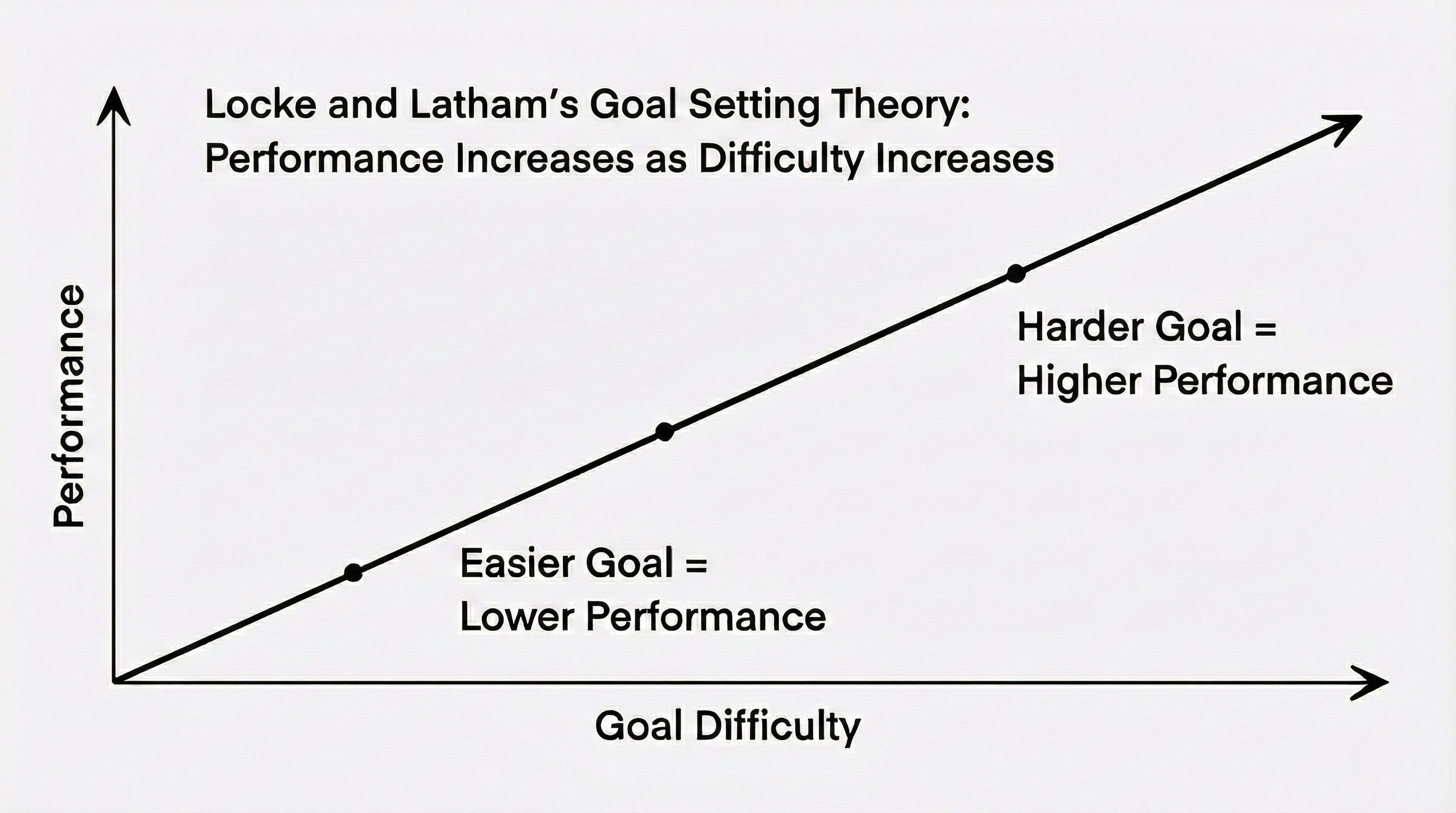
Why? Challenging goals trigger increased effort and focus.
Direction: Specific, challenging goals direct attention and action toward goal-relevant activities and away from irrelevant ones.
Intensity: People naturally adjust their energy expenditure to match the task's difficulty. Consequently, challenging goals stimulate greater effort than easy or moderate goals.
Persistence: In situations without strict time limits, challenging goals prompt individuals to work longer. When time limits are imposed, people work faster.
This mechanism occurs automatically as we naturally adjust our effort to match the difficulty of the task we undertake. Simply put, we try harder for challenging goals than for easy ones.
The ceavet? You must be committed to the goal and able to achieve it. If a goal is impossible (rather than just very difficult), then performance starts to decline. The bar needs to be high but not impossible for you to reach.
2. Big Goals Force Identity Expansion Leading to Real Behavior Change

Beyond effort and focus, big goals change who you think you are, and that shift drives behavior in ways small goals simply can’t.
Self-concordance research from psychologists Sheldon & Elliot shows that when goals require people to grow into a new identity, they become more motivated, more persistent, and more resilient.2
Identity alignment: Challenging goals naturally make you ask, “What kind of person achieves this?” That question alone prompts behavior change. You start acting less from your current habits and more from the habits of the person you’re trying to become.
Cognitive modeling: When the goal is big enough, your brain begins simulating the “future you” who could hit it: how they work, what they prioritize, the standards they hold. This mental modeling influences daily decisions long before the results show up.
Behavioral adjustment: Because the goal demands a better version of you, you adjust your choices to match: tighter systems, clearer priorities, more consistent habits. These upgrades happen automatically because your identity is stretching to close the gap between where you are and where you need to be.
This mechanism doesn’t activate with small goals. Small goals allow you to operate from your existing identity, while big goals require you to update it. Once that identity shift begins, behavior change becomes easier, not through willpower, but because your self-concept has changed.
3. Big Goals Create Productive Discomfort and Adaptation

Big goals also activate a physiological mechanism that small goals rarely touch: optimal arousal, the level of activation where focus, problem-solving, and learning peak.
This comes from the Yerkes–Dodson law, a well-established principle in performance psychology showing that humans perform best under moderate levels of stress. Too little challenge leads to boredom; too much leads to overwhelm.3
Ambitious goals naturally push you into that middle zone.
Increased activation: A challenging goal raises your physiological arousal just enough to heighten alertness, concentration, and cognitive speed. You feel more awake to the task, not depleted by it.
Enhanced learning: This moderate tension accelerates adaptation. Your brain pays more attention to mistakes, adjusts more quickly, and encodes new skills more efficiently when the challenge is meaningful.
Higher creativity under constraint: When the goal is big enough, you can’t rely on default patterns. You’re forced to generate new solutions, try alternative approaches, or remove friction. This is the zone where creative breakthroughs are most likely to occur.
Small goals don’t generate enough intensity to trigger this state, and overwhelming goals push you past it. But ambitious-but-achievable goals sit exactly where the nervous system performs best: high enough to drive growth, low enough to remain sustainable.
4. Big Goals Expose Constraints That Are Hindering Improvement

One of the most useful effects of ambitious goals is that they quickly reveal the bottlenecks holding you back. This principle comes straight from systems research, especially Goldratt’s Theory of Constraints, which shows that growth is limited not by effort, but by the single biggest constraint in the system.4
Big goals surface that constraint immediately.
Visible friction: A challenging goal makes inefficiencies impossible to ignore. Suddenly you can see where your workflow breaks down, where your energy drops, or where decision-making slows. The friction that felt “fine” under small goals becomes a clear obstacle under a big one.
Clear priority of fixes: Once the bottleneck is visible, it becomes obvious what needs to change. Instead of guessing or tinkering, you know exactly where to direct your effort—whether it’s improving your systems, tightening your habits, or removing distractions.
Faster improvement cycles: Because you’re operating closer to the edge of your capacity, feedback arrives sooner and more sharply. You learn what works, what doesn’t, and what needs adjusting. This accelerates your learning curve far faster than operating within a comfortable range.
Small goals allow constraints to stay hidden, but big goals shine a spotlight on them. Once a constraint is identified and improved, overall performance jumps, not just for this goal, but for everything you pursue after it, too.
5. Missing a Big Goal Produces More Progress Than Hitting a Small One

One of the most counterintuitive findings in goal research is that people often make more total progress pursuing a difficult goal they don’t hit than they do pursuing an easy goal they do hit.
According to Locke and Latham’s goal-setting theory, performance rises as goal difficulty rises—provided the goal is challenging yet attainable and there’s genuine commitment to it.
As difficulty increases, people naturally increase their effort, maintain focus for longer, and persist through obstacles. The result is more substantial output, even if the ultimate target isn’t reached.
Greater effort: Difficult goals stimulate more intense effort than moderate or easy goals. People work harder because the goal demands it and feels worth pursuing.
Higher performance levels: Across thousands of studies, Locke & Latham found that difficult goals consistently lead to higher performance than easy goals. Even when the exact number isn’t met, the performance level is still significantly higher than what an “easy-goal performer” would achieve.
More meaningful progress: Because challenging goals require more action, more creativity, and more problem-solving, people naturally accomplish more on the way to missing a hard goal than they do fully completing an easy one. Aiming for 10,000 subscribers and landing at 6,000 still dramatically outperforms aiming for 2,000 and hitting it.
Skill and capability development: Pursuing a difficult goal forces people to strengthen skills, adopt better systems, and push into new capacity ranges. These gains remain, regardless of whether the final number is met.
The essence of the research is simple: Difficult goals produce higher performance, even when you fall short. Easy goals produce lower performance, even when you hit them. This is why “missing” a big goal often moves you much farther forward than achieving a small one.
6. Big Goals Expand Your Thinking and Creativity

Another advantage of ambitious goals is that they broaden your thinking. When you set a goal that stretches beyond your current capacity, your brain can’t rely on familiar patterns; it has to generate new ideas, new strategies, and new ways of approaching the problem.
This effect is supported by Construal Level Theory, developed by Nira Liberman and Yaacov Trope, which shows that thinking about distant, challenging, or abstract future outcomes naturally shifts people into a higher-level, more creative mode of thinking.5
Research from Trope & Liberman demonstrates that when people consider goals that are further away (either in difficulty or time), they engage in more strategic, big-picture reasoning.
Broader perspective: Ambitious goals force you out of the weeds. You start thinking beyond immediate tasks and consider long-term options, structural improvements, and higher-leverage actions.
More creative problem-solving: Because your existing methods aren’t enough to reach the goal, you begin exploring alternative approaches, unconventional paths, or ideas you hadn’t considered before. Creativity becomes a necessity, not a luxury.
Better planning decisions: Higher-level thinking improves your ability to set priorities, anticipate obstacles, and allocate resources. You’re making decisions from the perspective of where you want to be, rather than where you are right now.
Higher tolerance for uncertainty: Ambitious goals often come with unknowns. Thinking at a higher level makes it easier to operate in uncertainty without shutting down or shrinking your aim.
Small, incremental goals rarely activate this kind of thinking. They keep your attention narrow and your problem-solving limited to what you already know how to do. Challenging, future-oriented goals do the opposite. They widen your cognitive space, increase your creativity, and help you see possibilities you would never notice while operating inside a comfortable range.
How BHAGs Drive Massive Performance Improvements (Examples)
Audacious goals work across every domain of life, not just business or metrics. That’s because the mechanism is the same: they stretch your identity, expand your capacity, and force you to build better systems.
Here are examples across a wide range of categories to show how BHAGs can look in practice.
Build financial independence by age 40/50/60.
Forces long-term planning, disciplined habits, and a re-evaluation of lifestyle choices.
Write a book that deeply impacts your niche.
Forces you to build a consistent writing cadence, develop deeper ideas, improve storytelling skills, and sustain long-term focus. A book is a system-builder.
Master a complex skill (e.g., data science, violin).
Requires deliberate practice, structured learning systems, and the capacity to push through frustration, all predictors of long-term performance.
Create a life where you work fewer hours but make more money.
Requires leverage, elimination of low-value tasks, and smarter not harder work patterns.
Double your publication’s growth rate in the next 6–12 months.
Forces you to analyze, prioritize, and repeatedly pull the levers that drive discovery and conversion.
Run your first marathon without burning out your body.
Requires improved training, recovery, and energy regulation, not just mileage.
Create a product that becomes the category benchmark.
Pushes you to understand customer needs more deeply, elevate design and UX, and pursue excellence instead of sufficiency.
Transition careers in one year.
Accelerates skill acquisition, relationship-building, visibility, and resilience under uncertainty.
Build a life anchored in calm instead of urgency.
Requires nervous system mastery, boundary-setting, and realignment of work habits, not just mindset.
Increase your project minimum from $2,000 to $10,000.
Forces you to elevate your offer, systems, and the caliber of clients you work with.
How to Set an Audacious Goal (Without Burning Out Your Nervous System)
Ambitious goals work best when they stretch you without pushing you into a state of overwhelm. Research on optimal arousal (Yerkes–Dodson) shows that people perform at their peak under moderate levels of challenge. Not too low, not too high.
The key is choosing a goal that’s big enough to activate those benefits without tripping your nervous system into shutdown.
Here’s how to do that in an ambitious, sustainable way.
1. Choose a goal that’s clearly beyond your current capacity, but still believable.
A useful rule of thumb:
If you can already map out every step to hit it, it’s too small.
If you can’t imagine any path at all, it’s too big.
Your goal should sit in the middle: challenging enough that it requires growth, new habits, and better systems, but still attainable with focus and commitment.
2. Make sure your goal is clear and concrete.
Ambitious goals are only helpful if you know what you’re aiming for. Research from Locke & Latham shows that specificity is crucial for directing attention and guiding effort.6
But concreteness doesn’t have to mean a number. A goal can be:
Quantitative: “Reach 10,000 subscribers.”
Qualitative: “Become a writer who publishes work I’m proud of every week.”
Identity-based: “Operate like a calm, strategic founder instead of a reactive one.”
Standard-based: “Produce the best newsletter in my niche.”
The key is that the goal is specific enough that you understand what it means and can tell whether you’re moving toward it.
3. Break the goal into identity-aligned inputs.
Big outcomes can be overwhelming. Inputs aren’t.
Identify the behaviors required to hit the goal and make those your focus:
Publishing frequency
Deep work sessions per week
Outreach or collaborations
Recovery habits
Energy management practices
These are all actions within your control.
4. Set checkpoints to recalibrate.
Big goals often require strategic adjustments. Build in periodic reviews (monthly or quarterly) to assess:
What’s working.
Where your systems need to evolve.
Whether intensity feels sustainable.
Whether the goal still meets the criteria of a BHAG.
Adjustment is part of the process for any goal that demands growth.
5. Look for constraints early and fix those first.
Big goals fail not because people lack willpower but because their systems can’t support the level of output required.
Identify and remove the bottlenecks:
Inefficient workflows.
Friction points.
Unnecessary obligations.
Energy drains
Tools or processes that slow you down.
Big Goals Work Better With a System That Supports Them
Big goals aren’t magic. They don’t transform your life because they’re bold or dramatic or inspiring. They transform your life because they change the way you operate.
A BHAG forces you to think differently, plan differently, and behave differently.
It stretches your identity, tightens your systems, and exposes every place where you’re coasting. And in the process of trying to reach something bigger, you start showing up as someone bigger.
But ambitious goals don’t live in a vacuum. They need context. They need clarity, direction, and a way to stay connected to the version of you you’re becoming.
This is where having a simple, steady framework matters. A way to define what success looks like, break it into meaningful priorities, and check in on your progress over time. This is the approach I take in the VISTA Framework, my yearly process for designing a successful year.

A BHAG gives you the stretch, VISTA gives you the path.
Put the two together, and you create the conditions for a year where you don’t just work harder, you change in ways that make bigger results possible.
To endless possibilities and a great year ahead,
Casandra
💬 Do you have a big, hairy, audacious goal for 2026? Share it here for support! (You can also encourage someone else in the comments while you’re at it.)
This is so interesting, Casandra! I’m proof that it’s true. At thirty, I became an unemployed single mother overnight. I had nothing and ended up back living with my family. I set myself one goal: buying an apartment so my daughter and I could move out. Everyone thought I was crazy. Two years later, I bought the apartment.
I do have a BHAG! To make the financial lives of 1,000 new paid subscribers better. I don't need scale; I want impact in this small part of the world I occupy.