


👋 Hey, I’m Casandra. I share really good business ideas to help you start and grow a business. I also share what I’m learning about building a business on Substack.
Become a Premium subscriber to access the full Substack archive and Premium Perks like my direct support.
Have you ever wondered about the optimal publishing schedule for a Substack publication? Publishing frequency is an important decision every publication needs to make, but it’s not easy.
The most honest answer you’ll get anywhere is: It depends.
There isn’t one perfect publishing schedule for every publication, and anyone who tells you otherwise is lying.
But we can figure out the optimal publishing schedule for your publication!
What Does The Data Say About Publishing Frequency? 📊
Publishing frequency is a powerful lever for growth. The more you publish, the more opportunities you have to gain traffic and subscribers.
Most Popular Publications Data
When I analyzed the most popular Substacks earlier last year, I found that most of them published new content multiple times per week.
This indicates that publishing frequency and publication growth may be related.
Really Good Business Ideas Data
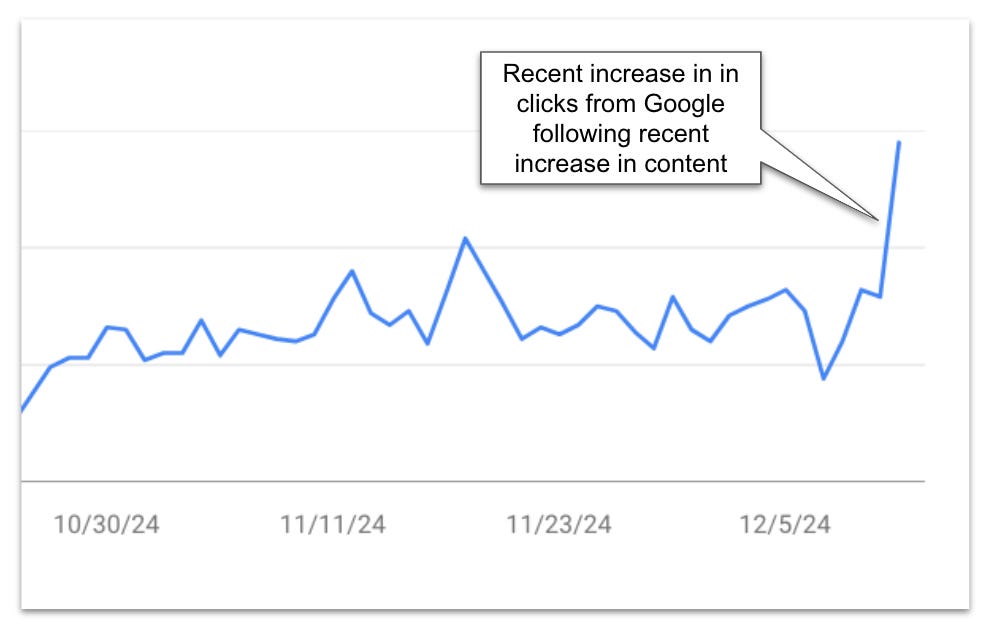
I’ve also seen this in my own publication. When I increased my schedule from once to twice a week in November 2024, my traffic jumped because I brought my subscribers back twice as often.

But it’s not just existing subscribers. I also saw increased new subscriber growth because I had more opportunities to promote my publication on social media.

Finally, I expect my traffic and subscriber growth to continue to increase in the coming months because I can now target twice as many search keywords. As more new content starts ranking, my traffic and subscribers will grow, too.
Bonus: More Frequency Means More Reps
Publishing more often doesn’t just help you increase your traffic and subscribers. It helps you become a better creator, too.
The more often you publish, the more reps you get in. Each article is a chance to experiment, try something new, get feedback, and improve your skills. The more you publish, the faster you improve, and that increase in quality will drive more publication growth.
Optimal Publishing Frequencies Vary 🗓️
Let’s face it. Starting a newsletter business is a bit like hopping on a treadmill. Once you start running, you can’t stop or you’ll go flying.
Unlike a casual blog, a Substack newsletter comes with the expectation that you’ll publish on a specific frequency. And once you start, it’s hard to stop without pushing the off button.
This is why choosing the right publishing schedule for your publication is essential. Funnel performance (meaning traffic numbers and subscriber conversions) isn’t the only thing that matters.
Consider Quality of Life
Your quality of life is important, too! There is a limit to what you can do with the time you have available and, more importantly, what you can do well.
You’re not a machine, so don’t act like one.
The same human limits exist in all work:
If you drive for Uber, you can always drive more hours to get more calls. But eventually, you’ll risk falling asleep behind the wheel.
If you bake cookies, you can always bake more cookies to sell. But you probably have other things you want to do with your time, too!
Consider Your Niche
The type of content you produce should also be a factor in determining the optimal publishing frequency. Although more is generally better, there is a logical upper limit to this. For example, most of us wouldn’t subscribe to a newsletter that sends a new email every minute.
That natural frequency limit for your publication will depend on the type of content.
I could probably read a new Uncharted Territories article before bed every night. However, I definitely wouldn’t read an in-depth report on the state of the SEO industry more than once a month. And people who follow breaking news may be interested in getting several updates daily.
My Publishing Frequency Recommendation 🧭
Here’s how I recommend you determine your optimal publishing frequency.
Since we know more is usually better, but most of us have a capacity limit (and don’t want to burn out), it’s helpful to figure out your maximum frequency first.
Figure Out Your Maximum Publishing Frequency
To figure out how often you should publish, you need to answer three questions:
How much time do I need to create content that exemplifies my unique selling proposition? Keep in mind this includes writing, editing, images, and optimization.
How much time do I need to work on the other parts of the publication? This includes promoting articles, building your audience on other platforms, conducting research, taking care of admin, and spending time on any other perks you might provide. If you’re unsure how much time to allocate, I recommend making this number equal to how much time you spend creating content.
How much time are you available to work on your publication each week? Think about both a good week and a bad week, so you have a more realistic range for how much time you can consistently allocate to your publication.
It's simple math once you’ve answered these three questions (rough estimates are fine).
Figure out how much time you have for content creation each week after you account for everything else you need to do to run your publication. Then, compare it to how long each article takes to produce. If you have 8 hours and each article takes 4 hours, you can publish twice a week. If you have 4 hours and each article takes 8 hours, you can publish every other week.
Round It Down
Once you have an estimate for your maximum publishing frequency, take that number and round it down. You want to be conservative here because it’s always better to over-deliver than under-deliver.
If you promise four articles a month but only deliver two, your subscribers may be disappointed. But if you promise two and deliver four, they will be delighted.
Price Accordingly
Whatever frequency you choose, factor that into how you price your publication. If you’re committing to publishing daily, you’ll naturally be able to charge more because you're delivering more value. (And you’re doing more work, so you’ll naturally want to charge more, too)!
But if you can only publish once a month, that’s ok. Just be realistic about how you price it. If it’s an in-depth report that takes 100 hours of research, maybe you can charge as much as the daily publisher. But if it’s a short personal essay, perhaps it makes more sense to charge less.
When In Doubt, Go With Weekly ✅
If you’ve gone through this exercise and you’re still unsure what to do, I recommend trying out a weekly publishing schedule.
Weekly works well for most people because:
Most of us think in weekly cycles already so the work fits into our schedules easily.
It’s frequent enough to keep you top of mind for your subscribers.
It adds up to four monthly articles, providing solid value for paid subscribers.
It has built-in flexibility because you can move around when you do your writing.
It’s not so frequent that you’ll get burned out or run out of ideas quickly.
You can also take a week off when you’re on vacation or need a break (Substack publishers also need PTO).
Remember that you’re still in control, no matter what frequency you choose. You can always experiment or change it if you need to!
Other authors: what publishing schedule works for you? Let us know in the comments! 💬
To endless possibilities,
Casandra

I also agree in that 2x per week is the sweet spot. I think if I were writing articles that were long form I could get away with 1x per week or even 1x per month, but what’s the fun in publishing that little? 😊
I would also add to run a check on how frequently newsletters in your subject area are publishing. That would give a barometer on how frequently the audience can take.
You may also want to opt for a alternating types of posts. Deep dive and shorter more digest types of posts where you scrape the web for interesting articles around a specific topic.