


Most social media algorithms are built to do one thing: keep you on the platform.
The longer you stay, the more ads you see, so the feed learns to serve whatever holds your attention the longest. Often, that turns out to be outrage. It’s why our feeds fill up with rage-bait, and we get sucked into doomscrolling that leaves us feeling like crap.
Substack is built on a different incentive. It earns a cut of subscription revenue, not ads, so it has no reason to trap users in an endless scroll. Co-founder Hamish McKenzie put it plainly, "We only make money when you make money, and you have the ability to leave anytime you want."1
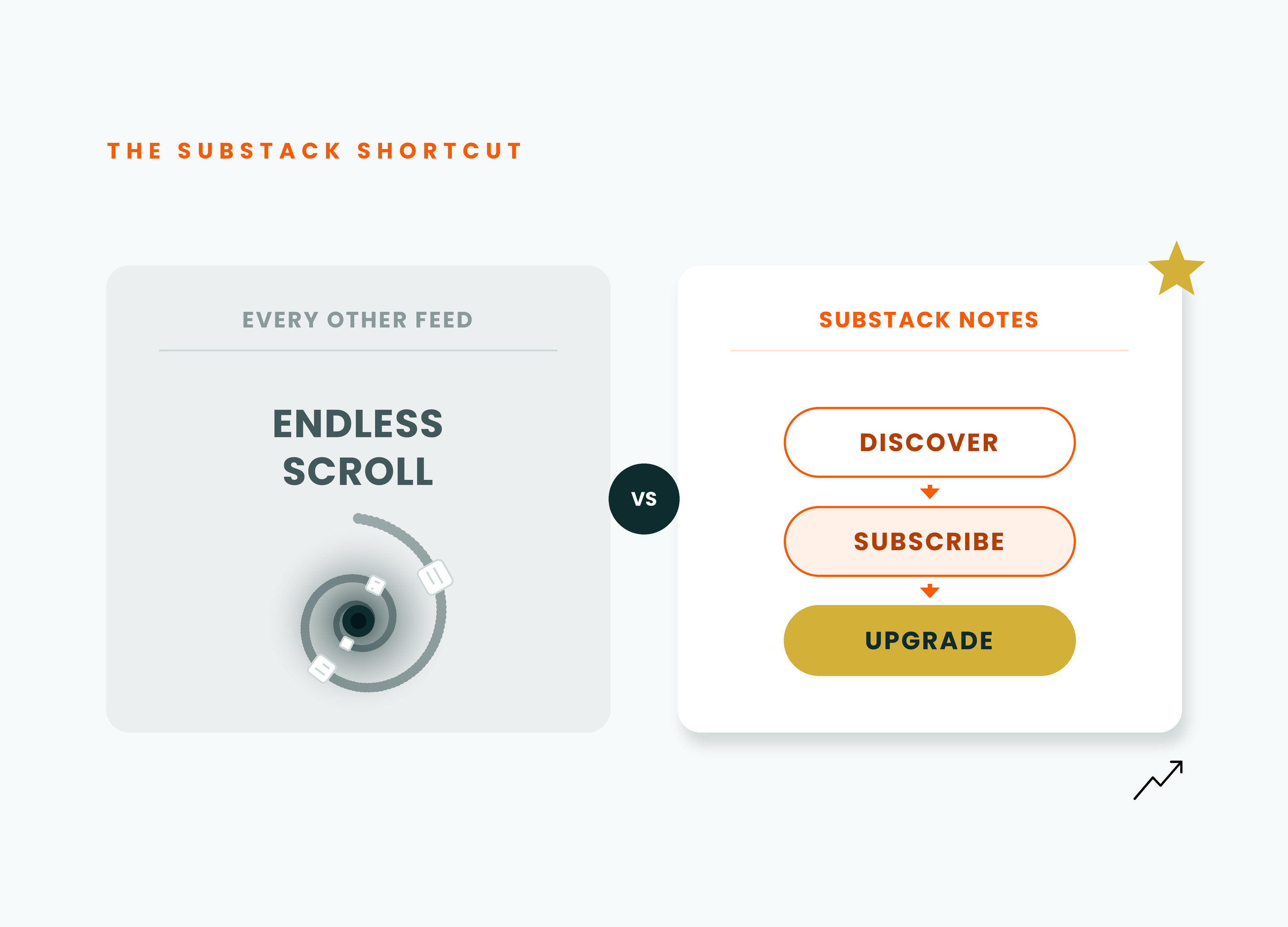
And yet, most publishers still approach the Notes feed the way they’d approach any other algorithm, testing posting times and copying whatever went viral last week. They don’t realize that the Substack algorithm is different.
Last week I made the case that the only way to beat an algorithm is to think like one, using the explore-exploit loop that powers everything from Netflix recommendations to drug trials. This week is the companion piece: a deep dive into the specific algorithm you’re working with on Substack, with insights from the head of machine learning who built it. It runs on a different objective than the feeds you’re used to, so your approach to mastering it needs to be different, too.
Table of Contents
What Does the Substack Notes Algorithm Optimize For?
The Substack Notes feed is built to turn readers into paying subscribers, not to keep them scrolling. That single goal explains everything else.
The Substack Notes feed optimizes for one thing: getting readers to discover publications, subscribe, and eventually pay.
It does not optimize for time spent in the app or for raw viral reach, which is the core difference between it and almost every other social feed. As Mike Cohen, Substack’s head of machine learning, put it, “The goal is to get people to discover, subscribe, and ideally pay.”2
“The goal is to get people to discover, subscribe, and ideally pay.”
Cohen was specific about how other feeds make their money, and it lines up with what we all feel scrolling them: “You scroll the feed, and the more time you spend, the more ads you see. Their objective is to decide what ads you’ll click and show them at the right time.”
A lot of Notes advice ignores how the feed works and treats it like every other platform. Apps like Instagram and X optimize for attention, so tactics borrowed from them often don’t translate to Substack.
On most social media networks, adding a link to a post tends to hurt its reach, since the platform would rather keep people from leaving. On Substack, getting readers to your posts is the whole point, so you can link to your own articles without watching your reach drop.
Substack profits only when a reader becomes a paying subscriber to one of its writers, so its feed is optimized to connect people with writers they’ll want to pay for, not to keep them scrolling.
How Does the Substack Algorithm Decide What to Show You?
The Substack algorithm analyzes each reader and shows them more of whatever they engage with. It doesn't favor any format, so there's no secret format or posting trick to crack.
The Substack algorithm feed builds a numerical profile of each reader, based on who they are, where they live, what language they speak, who they follow and which publications subscribe to, and the interests they’ve set, then compares that profile against candidate posts to decide what to load.3 Substack recently rebuilt part of the algorithm so readers don’t get permanently boxed into a single topic. It has no built-in preference for any format, so a long-form essay, a one-line text note, and a short video all compete on the same footing.
There is no secret format the algorithm rewards, which kills a myth that a lot of publishers still believe. Cohen was blunt about it: "There's no prior belief about what's good. It's about what's best for you." If a reader loves video, they see more video. If they only want long-form, the feed leans that way for them. Don't worry about trying to guess Substack's preferred format. Make the thing your specific readers will engage with, and let the feed sort out who sees it.
The feed also won't lock readers into a single topic. Cohen described recent changes to "the core retrieval step" so that someone on a poetry streak keeps getting poetry, "but not forever." For us publishers, that means a note outside of our usual topic can still find the right readers, even when it doesn't look like what we normally post.
One caveat: Substack has told us what the feed optimizes for and roughly how it represents readers, but not how it weights those signals. "A numerical representation" is still a bit of a black box, so think of this information as directional rather than definitive.
Who Can See Your Substack Notes?
Your notes reach your own followers and anyone their replies and restacks travel to. Engaging with other writers is what expands that reach.
Your notes can reach three distinct groups:
The people who already follow or subscribe to you.
The audiences of any publication that recommends you.
Anyone whose feed surfaces a restack, reply, or comment on your note from someone they follow.
The further a note travels through restacks and replies, the deeper it reaches into those second- and third-degree networks. According to Substack’s support documentation, this is exactly how the Home feed is assembled.
Underneath that is the thing that drives reach: audience overlap. When two publications share readers, Substack treats that overlap as a signal and starts showing each audience the other’s work. Cohen explained why on-platform actions feed this so well: restacks and quotes “all happen on the Substack platform, which means we can understand the full life cycle of behavior and help intersect audiences.” When the system spots overlapping audiences, “that becomes a virtuous cycle.”
This is the part most growth advice gets right by accident. People tell you to restack and reply because it helps build relationships. The deeper reason is mechanical: every restack and reply is data that helps Substack map which audiences belong together. On Notes, engagement is part of how the feed calculates distribution in the first place. It’s the same pattern I dug into in my article, Your Next 100 Followers Are Closer Than You Think: the fastest organic growth tends to come from second-degree connections, the people who already follow whoever you engage with.

A couple of mechanics are easy to miss. Notes don’t go out by email the way posts do, though subscribers may catch them in a notes roundup digest or a push notification. And notes have an unusually long shelf life, often resurfacing days or weeks after you post them, which I covered in more depth in Substack Notes Explained. That piece also includes my mini-study finding that most of the people in the Notes feed are other Substack authors, so write with that in mind.

What Actually Drives Reach on Substack Notes?
Substack shared five recommendations for growing on Notes and backed each with real numbers. The biggest lever is being clear about what readers get from you.
The five things that drive growth on Notes are reaching beyond your current audience, posting consistently, being clear about your value, engaging with others, and cross-posting to other platforms. These come straight from Substack's own recommendations, and the team backed each one with real publisher results.4 Here's what they found, and why each one works.
1. Reach beyond your existing audience.
Every note is a chance to introduce yourself to someone who's never heard of you. This is the whole point of the feed surfacing your work to overlapping audiences, so write at least some notes for strangers (aka future readers), not just subscribers who already get your emails.
2. Publish consistently.
Fashion writer Viv Chen has seen roughly 30% of her total subscribers come directly from her notes, and Substack found that her steady, consistent posting grew her audience more than the occasional viral hit did. Many of her best-performing notes are casual and observational rather than polished, detailed content.
Showing up regularly keeps you in circulation and gives the feed more chances to match you with the right readers.
3. Be clear about your value.
This one has the most dramatic receipts. Julie Fratantoni, PhD, posted a note that explicitly explained who she is and why she's on Substack, which drove 32,535 new subscribers and a $4,546 revenue increase.
Anna Lena Feunekes paired illustrations with a crisp explanation of what her newsletter delivers and picked up nearly 4,000 subscribers from a single note.
Food creator Olivia Noceda posted a short cooking video that made her value obvious, which brought in 437 new subscribers and $480.
When the feed hands your note to a stranger, make it easy for them to understand what they get from subscribing.
If you haven't nailed that down yet, start with my guide to your unique selling proposition. It's hard to communicate a value you haven't defined.

4. Engage.
Reply, restack, and endorse other writers, especially ones you genuinely admire. Substack found that signal-boosting other publishers and joining the wider conversation are both linked to noticeable growth, which makes sense once you know that engagement is how the system maps audiences together. Highlight people whose work you respect, and don’t be shy about sharing when they do the same for you.
Replying and restacking is just the start. For bigger collaborations like recommendation swaps and guest posts, I broke down seven ways to collaborate on Substack.
5. Cross-post with intention.
If you already have an audience elsewhere, use it. Justin Welsh shares his notes to LinkedIn, and Anna Kai turns hers into carousel posts on Instagram, both using outside networks to spark curiosity that sends new subscribers back to Substack. A note doesn't have to live and die inside the Substack app.
For ideas and real examples of what to actually post, from behind-the-scenes peeks to milestone celebrations, I wrote a whole list in 16 Ways You Should Use Substack Notes.
Why Notes Is the Best Place to Run Experiments
Notes are quick to post and include per-note stats, making them the ideal place to test ideas and double down on what works.
Notes is the ideal lab for the explore-exploit loop. They are quick to create, and you get real data every time you post. When you open a note’s stats, Substack shows you the revenue it generated, the new paid and free subscribers it brought in, your new followers, and total clicks and shares.
That feedback speed is what makes the loop work. You can explore by testing different hooks, topics, formats, and tone in small batches, measure which ones pull in the right subscribers, and then exploit the winners by doing more of what worked. Because notes are easy to make and resurface for weeks, you get a lot of shots on goal without burning yourself out. The explore-exploit playbook walks through the full system if you want the step-by-step.
Claude Hooks Skill: Get Hook Options and Find the Pattern in Your Winners
Your hook is the line that stops someone mid-scroll and gets them to read the rest. The hardest part of testing on Notes is writing hooks that differ from each other, not three versions of the same thing. And when one finally performs, it's easy to celebrate and hard to know why, so the next time you're left guessing all over again.
That’s why I built the Claude Hooks Skill for Really Good Business Ideas Premium members.
Paste your topic into Claude, and it drafts a batch of hooks built on different proven patterns (a contrarian take, a curiosity gap, a numbered promise, a personal angle, and more), so every test pulls a different lever. It draws on 200 proven hook templates across 10 categories, so the options are never cookie-cutter. It works in reverse, too. Paste in the notes that got a lot of engagement, and it names the pattern they share, so you can intentionally repeat what worked.
To use it, all you need to do is add the Really Good Business Ideas Connector to Claude, then start a chat and type something like "Give me a batch of hooks for a Substack note about my irrational loyalty to a team that breaks my heart every season." or "Here are my five top-performing Substack notes. What do they have in common?"
Stop Trying to Game the Feed
There’s nothing to game in the Subtack feed. Simply post like yourself, post consistently, and let the algorithm do the rest.
It turns out we can let go of a lot of the rules we think we're supposed to follow. There’s no best time to post and no format the feed secretly favors. Writing long instead of short doesn’t cost you anything, and the viral moment you’re chasing isn’t what grows you anyway. Most of what publishers worry about with Substack’s algorithm was never a real problem in the first place.
What’s left is simpler, if less exciting. Keep telling people who you are and what you do, and stay engaged with the writers you like. That’s what the feed rewards, because that’s what turns a stranger scrolling past into someone who subscribes and pays.
You don’t need a growth-hacking playbook. You only need to be yourself and share your unique value as you participate in the community.
To endless possibilities,
Casandra
Need More Help?
Really Good Business Ideas Premium: A membership designed to make starting and growing a profitable business easier. Full archive access, DM support, and a library of tools and resources.
Substack Creator OS: A complete operating system for planning, writing, growing, and monetizing your newsletter, all in one connected Notion workspace. (Right now, it’s free for Premium subscribers).
Work With Me Directly: Book a 1-on-1 consultation or coaching call to get personalized help when you need it. Think of it as a focused working session to get unstuck, gain clarity, or move something forward.
Build Your Brand on Substack: Whether you’re still deciding or ready to build, I’ll meet you where you are. I offer executive briefings and hands-on strategy sessions for marketing teams that want to win on Substack.

"Simply post like yourself, post consistently, and let the algorithm do the rest. It turns out we can let go of a lot of the rules we think we're supposed to follow."
Now THIS is something I can happily do! 😊 Thank you for sharing such helpful insights!
I really like the concept of Claude Connect. Developing a simple connector is a great starting point, rather than building custom apps or investing in expensive IT platforms. Thank you!