


If you’ve been wanting to turn your knowledge into a course, my friends at Write • Build • Scale are running a free live webinar on March 11th that’s worth showing up for.
They’ve helped hundreds of creators build and launch mini-courses. In this session, they’ll walk you through exactly how to go from idea to first sale, even if you don’t have an audience yet.
It’s free to join, and if you decide you want to go deeper, their Mini-Course Accelerator program opens the same day.
Jacques Hopkins was an electrical engineer. Not a musician or a teacher. Just someone who’d spent years teaching himself piano and figured other people probably wanted to learn the same way he had: fast, without sheet music, playing songs they actually liked.
So he built a course called Piano in 21 Days. It has now done over $4 million in sales.1
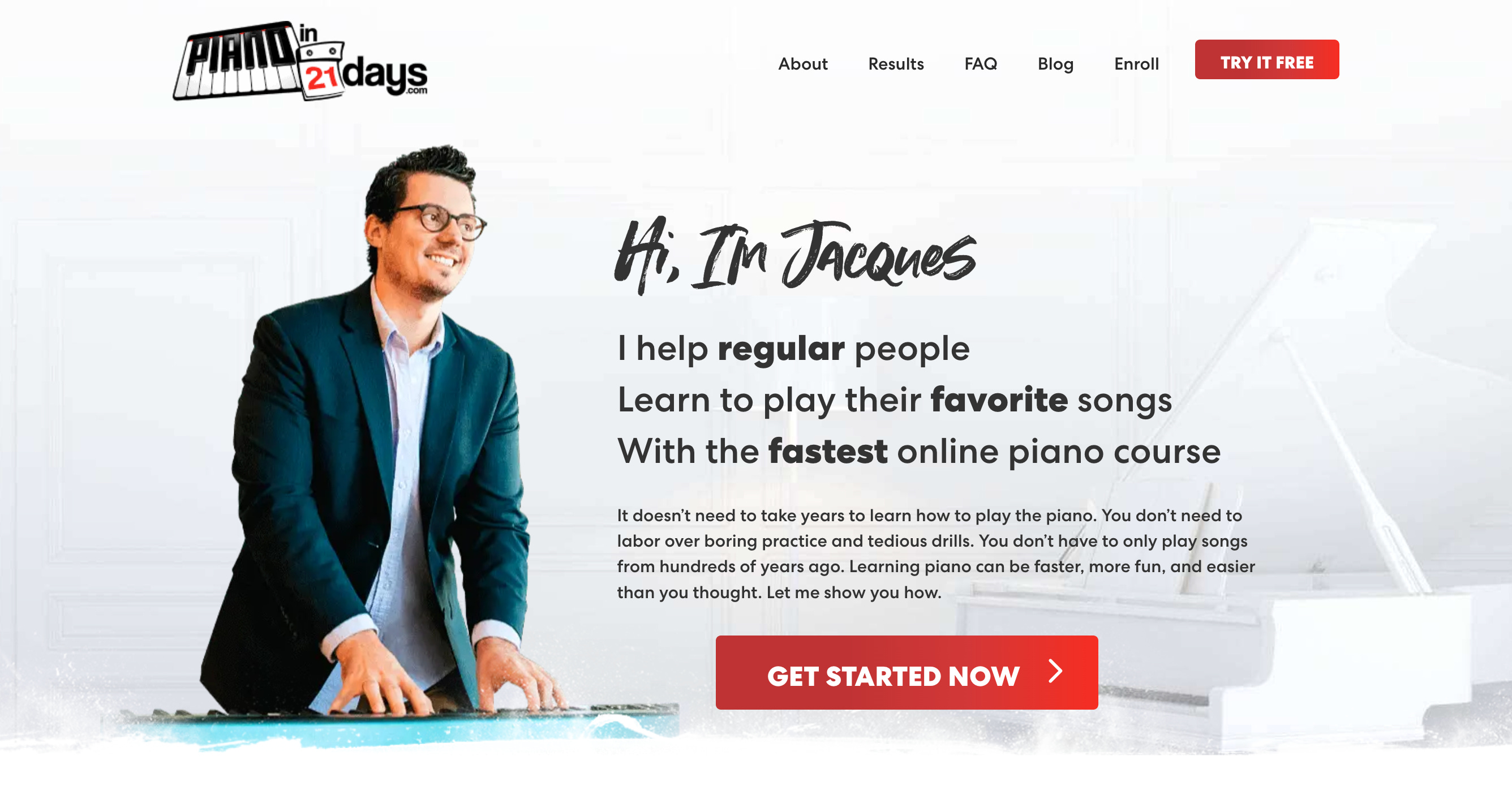
I really believe that everyone has something they can teach. The question is how to figure out what it is for you.
You don't need to be the best in the world to teach something. It wasn’t the world's leading pianist who built a $4 million course business; it was an engineer who just loved playing. Like Jacques, your value might be that you're close enough to the beginner experience to still remember every obstacle.
Or it might be that you have a unique point of view based on your own experience:
The ex-McDonald's manager who teaches operational efficiency to small business owners.
The former debt collector who teaches people how to negotiate their own debt down.
The socially anxious introvert who teaches networking because they had to build a completely different system to make it work for themselves.
Your course’s unique value proposition doesn't have to be that you are the world's expert. You just have to have something you can teach that others want to learn. And I already know you do!
Why Courses Are a Great Business Opportunity for Creators
The simplest way for creators to earn revenue relies on trading time for money. Freelancing, consulting, and coaching all scale with your hours, and once you hit your capacity, you hit your ceiling. The only way to earn more is to work more, charge more, or burn out trying to do both.
Courses don’t work that way.
The same lesson you record today can be watched by ten people or ten thousand, and the work you put in is exactly the same either way. You can build it once and sell it indefinitely without any additional time spent teaching.
That’s a different relationship between your time and your income, which is why so many creators, freelancers, and service providers are adding courses to their business. Not to replace what they do, but to build something that earns while they sleep, take holidays, learn new skills, or focus on the work they find most fulfilling.
The numbers are hard to argue with, too. A $297 course sold to 50 people generates nearly $15,000. A $497 course sold to 100 generates nearly $50,000. And most courses only get easier to sell over time because every launch builds on your growing audience, testimonials from previous students, and the reputation you’ve already established.
The global e-learning market is worth over $342 billion and expected to double by 2033,2 which means the opportunity for online courses is only getting bigger.

You only need to capture a tiny portion of the e-learning market to make your course worthwhile. All you need is an engaged audience, even a small one.
How to Create Your First Course Step-By-Step
Whether you've got a fully formed idea or just a vague sense that you have something worth teaching, the steps below will help you get there. Don't skip the validation step!
Step 1: Find the Right Topic
The best course topics sit at the intersection of what you like, what you’re good at, and what people would pay you for. Sometimes a little bit of reflection is needed to figure this out.

Here’s how to find that overlap using data.
Look at Your Own Data First
If you already have an audience, even a small one, start here. The signals are right in front of you.
Content Engagement: Which posts got the most saves, shares, or replies in the last 90 days? High engagement means you hit a real nerve.
Comments and Replies: Which topics drove the most replies? Replies are one of the strongest signals of genuine interest.
Common Questions: What questions do people ask you repeatedly? If you’ve answered the same question five times this month, that question could probably be the foundation of a course module.
Validate Demand Beyond Your Audience
Once you have a shortlist of ideas from your audience, check whether demand exists outside your existing following.
Google Trends: Research topic in Google Tends and check whether interest is stable or growing. You want to see consistent or rising search interest before investing a lot of time.
Keyword Research: Type your topic into a keyword research tool to see the exact questions people are searching for. These questions often become your course modules.
Reddit and Facebook Groups: Search for your topic in relevant communities. What are people asking about and struggling with? The questions that come up again and again signal course demand.

Check Your Topic Against These Three Questions
Once you have two or three strong candidates, run them through this filter. A viable course topic needs all three:
Passion: Are you genuinely interested in teaching this? You’ll be talking about it a lot.
Qualification: Have you solved this problem yourself? You don’t need to be the world’s leading expert, but you do need to genuinely help the people who take your course.
Demand: Is there evidence that people are actively searching for help with this topic? Engagement data, search trends, or repeat DMs all count.
If you find a topic that hits all three, you have a winner!
Step 2: Define the Outcome
People don’t buy courses. They buy a result.
Your potential students don’t care about your module count, your video length, or your production quality. They only care about what they will gain from taking your course.
Define your course outcome before you build a single lesson.
Map the Before and After
A good course outcome moves someone from a specific Point A to a specific Point B. The more concrete you can make both ends of that journey, the easier your course will be to build and sell.
Remember, specificity is what makes an outcome sell. It makes a concrete promise and gives the buyer a clear picture of what their life will look like on the other side.
Write Your Outcome Journey
Use this fill-in-the-blank formula to define your outcome before you write a single lesson:
My course helps [specific person] go from [Point A] to [Point B] in [timeframe].
Example: My course helps beginners go from never having picked up a camera to taking photos they're proud of in 4 weeks.
If you can’t complete that sentence clearly, your course idea isn’t focused enough yet. Keep working on it until you can.
Step 3: Validate Before You Build
This is the step that separates creators who make money from those who burn out. Validating your course before you build it means confirming that real people will pay real money for your idea, before you invest weeks (or even months) of your life creating it.
I know it sounds obvious, but in my experience, most people skip this step.
There are three practical ways to validate, each suited to a different situation. For each of these options, look for at least 1% of your list to show interest to be sure there is real demand.
Option 1: The Waitlist Email
Best for: Quick validation before you start building.
Write a short, honest email to your list. Tell them you’re considering building a course on your topic and want to gauge interest before investing time. Include a link to a simple waitlist form or a pre-order page with an early-bird price.
Option 2: The Paid Live Workshop
Best for: Creators who want to test both content and demand simultaneously.
Offer a 60-90 minute live workshop on your course topic at a low price point, typically $25-$75. This lets you test demand and gather real feedback before you’ve built anything more robust.
Even 10-15 paying attendees is meaningful. Focus on whether the questions and feedback point to a deeper need that a full course could address.
Option 3: The Live Beta Cohort
Best for: Creators who are confident in their topic and want to build and validate at the same time.
Sell access to a live cohort-based version of your course before you’ve built the full recorded version. Deliver one module per week as you create it, with live Q&A sessions alongside. Students get a more interactive experience; you get real-time feedback that shapes the final product.
This approach also generates early testimonials, which are essential for your next launch.
⚠️ A critical note on validation: Asking people if they would buy your course is not validation. People say yes when it costs them nothing. Real validation means someone hands over real money. Until that happens, you don’t have proof of demand; you have polite encouragement.
Step 4: Structure Your Course for Completion
Once you’ve validated your course, it’s time to start building it!
The biggest structural mistake first-time course creators make is trying to include everything they know. More content doesn't mean more value. Completion rates drop sharply as course length increases. A focused, completable course will usually outperform an exhaustive one (especially in today’s era of treatonomics).
How to Structure Your Modules
Each module should cover one major phase of the course. Each lesson inside it should focus on one concept or action, with a clear outcome that the student can act on.
Here’s what this structure looks like in practice, for a hypothetical course called Land Your First Freelance Client in 30 Days:
Module 1: Foundations
Lesson 1: Define your niche
Lesson 2: Identify your ideal client
Lesson 3: Write your positioning statement
Module 2: Your Offer
Lesson 1: Package your services
Lesson 2: Set your rates
Lesson 3: Create a one-page service guide
Module 3: Finding Clients
Lesson 1: Build a prospect list
Lesson 2: Write your outreach messages
Lesson 3: Warm outreach
Lesson 4: Cold outreach
Module 4: The Sales Conversation
Lesson 1: Run a discovery call
Lesson 2: Handle objections
Lesson 3: Close without feeling pushy
Module 5: Getting Paid and Delivering
Lesson 1: Send a proposal
Lesson 2: Set up a contract
Lesson 3: Deliver your first project
With a clear progression and one goal per lesson, a student who completes this course will have landed their first client by the end.
A Guiding Principle
Before you add any lessons, ask yourself: Does this directly move the student closer to the promised outcome? If the answer is no, or even “kind of,” cut it. Save it for a bonus module or your next course. Staying focused on outcomes is what makes your course successful.
Step 5: Choose Your Format and Tools
There’s no single right way to deliver an online course. The format you choose should match what your audience prefers, what you’re comfortable with, and the nature of what you’re teaching.
Self-Paced (Pre-Recorded)
Students access lessons on their own timeline. This is the most scalable format because you record once, and the course runs indefinitely.
Best for: Clearly defined skills where students don’t need real-time feedback.
Biggest risk: Completion rates are lower without the social pressure of a cohort.
Live Cohort
Students go through the course together on a fixed schedule, with live sessions each week. High engagement, high completion rates, and premium pricing are the main advantages of this format.
Best For: Topics where community and accountability drive results, like fitness, business, or creative skills.
Biggest Risk: Every cohort requires your time. It won’t run without you.
Hybrid
Pre-recorded lessons plus live elements, typically weekly Q&A calls or a community forum. A good middle ground for most first-time creators.
Best for: Creators who want to scale without completely giving up the live experience.
Biggest risk: It's easy to underdeliver on both the live and recorded elements if you don't plan the balance carefully.
Step 6: Price It Properly
Pricing is the part most first-time course creators get wrong, and almost always in the same direction. They underprice.
Underpricing doesn’t make your course more accessible. It signals low value, attracts buyers who are less committed to doing the work, and makes the economics of a sustainable course business nearly impossible.
How Much Should You Charge?
$47-$97: Mini courses. Short, focused, typically one to three hours of content. Good for building a buyer list, but not a business on its own.
$197-$497: The sweet spot for most first full courses. Long enough to deliver real results, priced high enough to be taken seriously.
$497-$997: Appropriate when your course includes live elements, community access, or a highly specific professional outcome.
$997+: Premium courses with strong personal access to you, such as coaching calls, direct feedback, or a high-value certification.
How to Choose Your Price
Run through these three questions:
What is the outcome worth? If your course helps someone land a $5,000 client, charging $97 is nothing. Price relative to the value of the outcome.
How much does your audience trust you? A new audience with no track record of buying from you may need a lower entry point. An audience who has bought from you before can start higher.
What level of support are you including? The more access students have to you, live calls, direct feedback, and community, the higher you can and should price.
A note on discounting: Early-bird pricing for a launch window (typically 20–30% off) is a legitimate and effective tactic. Permanent discounting is not. If your course is always on sale, buyers learn to wait, and your full price loses all meaning.
Step 7: Launch to the People Who Already Want It
A course launch doesn’t have to be complicated, especially your first one. The goal is to get your course in front of the people who already trust you, make it easy for them to buy, and give them a clear deadline.
A Simple Four-Email Launch Sequence
Email 1: The Introduction (7 days before launch). Tell your audience what’s coming, why you built it, and who it’s for. Link to a waitlist.
Email 2: The Outcome (3 days before). Share the before and after. What does life look like before your course? What does it look like after? Use a story or a real example.
Email 3: Launch Announcement (launch day). Doors are open. Clear call to action, specific deadline, and early-bird pricing if applicable.
Email 4: Enrollment Closes (last day). Final reminder. Reinforce the outcome, restate what they’ll miss, and close enrollment.
Set Realistic Expectations
A first launch to a small, engaged audience of 500-1,000 subscribers generating $500–$5000 in revenue is a strong result. A real, repeatable business that gets bigger with every subsequent launch.
That same course, relaunched four times a year to a steadily growing audience, can become a six-figure product without you ever building anything new.
Expanding Beyond Your Email List
If you want to reach beyond your existing audience, these channels are worth adding to your launch:
Partnerships: Find other creators with audiences who may be interested in your course to collaborate with. This can help you both grow your audiences and give you access to new potential students.
Affiliate Marketing: Offering an affiliate program for your course can further incentivize partners to collaborate, and you only pay commissions on real, paying students.
Paid Ads: Paid ads are a great way to scale your course once you understand your conversion rate and have worked out the kinks in your sales funnel. Unless you have a lot of money to throw around, I do not recommend running ads for a landing page that hasn’t already converted real buyers from organic traffic.
The Biggest Mistakes New Course Creators Make
Building before validating. This is the most expensive mistake you can make in time, energy, and motivation. Always validate first.
Pricing too low. Low prices don’t necessarily attract more students, but they do attract less committed ones. Price for the value of the transformation.
Trying to cover everything. Comprehensive courses have low completion rates. Focused courses are more likely to be completed, drive results, and be recommended.
Waiting for perfect production. Your first course doesn’t need a studio setup or broadcast-quality audio. Students care more about outcomes than aesthetics.
Launching once and moving on. Most successful course creators generate more revenue from their second and third launches and beyond. Keep building your audience and relaunch regularly. You’ll get results over time.
Launched Is Better Than Perfect
The creators who build sustainable course businesses aren’t the ones with the best cameras or the most polished slides. They’re the ones who validated a real idea, built something focused, and launched before they felt ready.
Perfection is a comfortable excuse to stay in planning mode, but your potential students don’t need a perfect course. They need the transformation you’re already capable of delivering.
If you’re still deciding where to start, mini-courses are a great option. They’re faster to build, easier to price, and because they promise a focused outcome, audiences find them easier to say yes to.
If a mini course sounds like a good way for you to launch your next course business, my friends at Write • Build • Scale are running a free live webinar on March 11th covering the whole process from idea to first sale.
To endless possibilities,
Casandra
Casandra, nailed it, validation before build saved my first course launch.
This was a great read! I'm working on a mini-course now and this helped me refine a bit what I actually want to accomplish with it