


You’ve felt it before. You walk into a room and, within minutes, it just works. Conversations flow, people are relaxed but engaged, and there’s a sense of shared energy that doesn’t need to be forced.
You’ve also felt the opposite: a well-designed space, impressive speakers, maybe even a strong brand, but the room feels fragmented. The awkwardness causes people to linger on their phones or cluster with those they already know.
The difference usually isn’t the venue, the programming, or the aesthetics. It’s who’s in the room, and how well they fit together.
New research published in the Journal of Marketing makes this explicit: the most successful experiences don’t rely on vibes or luck. They engineer social chemistry by deliberately shaping who shows up, how they behave, and what the group becomes together.1
Once you start thinking about experiences as social systems, everything changes.
This framework doesn’t just apply to nightclubs or festivals. The same dynamics show up anywhere people gather around a shared experience including:
Brand events.
Membership communities.
Meetups.
Paid newsletters.
Slack groups.
Clubs.
Cohort-based courses and programs.
By the way, offline events that prioritize deliberate social experiences (in contrast to the enshittification of digital platforms) are a big marketing trend for 2026. I call this the unshittification, and you can read more about the business opportunities it’s creating here:

To make the social systems that power magnetic events and communities practical, the research points to a small number of repeatable decisions that shape how social chemistry emerges.
What Social Chemistry Actually Means
Social chemistry isn’t hype, energy, or extroversion. In the research, it shows up as something more specific:
People feel safe enough to participate.
Behavior syncs naturally (how people talk, move, interact).
Differences feel complementary instead of tense.
Note, the goal is not sameness. The strongest experiences combine:
Shared expectations about behavior.
Enough diversity to make the room interesting.
Clear norms that prevent friction from taking over.
The mistake most creators and organizers make is chasing maximum growth or maximum diversity without designing the conditions that allow those differences to coexist productively.
What the Research Shows

This framework draws on research published in the Journal of Marketing that examines how social chemistry is actively produced rather than left to chance.
The study is based on ethnographic research inside Berlin’s underground electronic music club scene. The authors chose this setting intentionally: in these clubs, atmosphere is the product, and crowd dynamics can make or break the experience in minutes.
Importantly, this was not just passive observation. The researchers used a multi-method qualitative approach designed to capture both what people say and what they do.
How the Research Was Conducted
The dataset combines three complementary sources.
1. In-Depth Interviews
The researchers conducted interviews with people directly involved in creating and experiencing club atmospheres, including:
Bouncers and security staff.
Event organizers and club owners.
DJs and scene experts.
Regular clubgoers.
Interviews focused on how nights are curated, how inclusion and exclusion decisions are made, how people prepare to attend, and how they experience acceptance or rejection.
2. Real-Time, Nonparticipant Observation
To capture behavior as it unfolded, the researchers shadowed selectors at the door of a renowned Berlin club for an entire night, observing. They recorded verbal and nonverbal cues, micro-interactions, and informal explanations behind rapid yes/no decisions.
3. Archival and Cultural Analysis
The research team also analyzed documentaries, media coverage, and industry reports on Berlin’s club culture. This contextual work helped situate individual decisions within the city’s broader cultural, economic, and historical dynamics.
What the Researchers Were Trying to Understand
The central question wasn’t why Berlin clubs are exclusive. It was:
How can organizations manage social fit among diverse participants in order to stage successful social atmospheres?
As the fieldwork progressed, the researchers discovered that clubs don’t rely on a single moment of gatekeeping. Instead, they manage social fit before people arrive, at the point of entry, and after people are inside.
From iteratively coding interviews, observations, and archival material, the authors inductively identified three recurring mechanisms:
Cultivation: Filtering expectations and signaling fit before attendance.
Selection: Making real-time inclusion and exclusion decisions at the door.
Mystification: Preserving meaning and trust by keeping curation criteria partially opaque.
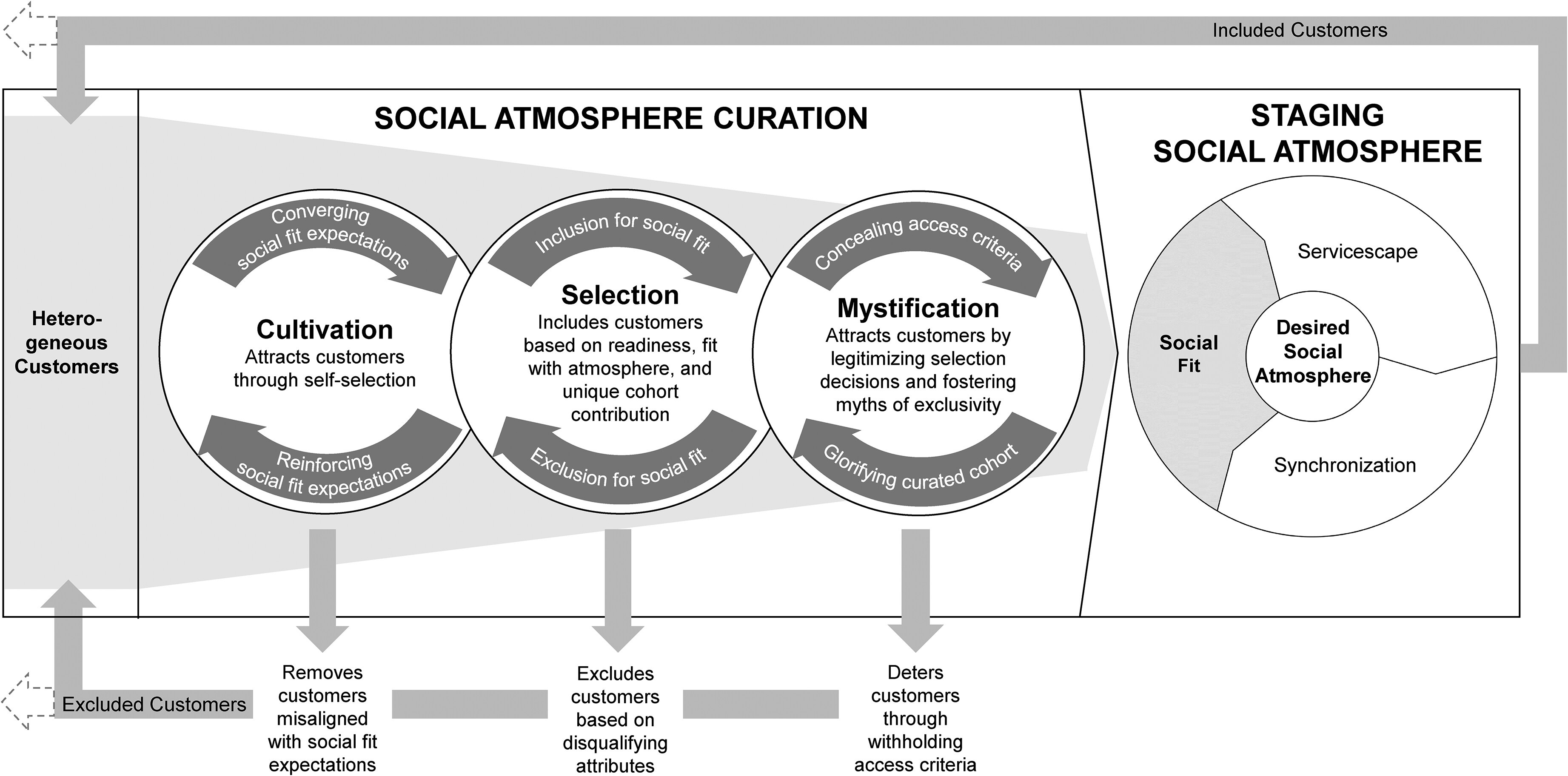
These mechanisms were identified in Berlin’s club scene, but the authors are explicit about their broader relevance: they apply to any experience that depends on participant interaction.
These aren’t just abstract ideas; they’re observable practices that show up again and again in the most magnetic experiences. And you can replicate them in your own communities and events.
Whether you produce brand events, manage an online community, or run a members-only club, this same framework can be used to deliberately shape the social dynamics that turn one-off attendance into loyalty, word-of-mouth, and repeat participation.
The Social Chemistry Framework: How to Engineer Magnetic Events and Communities

The Social Chemistry Framework is a simple way to think about how experiences actually work when people are involved. Drawn from research into how social atmospheres are actively produced (not left to chance), it focuses on the conditions that shape how people behave once they’re together. It translates those insights into a small set of concrete levers you can use to intentionally shape how people show up, interact, and contribute, whether you’re running an event, a community, or an ongoing program.
