


Sorry, but the Web 2.0 playbook expired in 2025.
For the last decade, the rules were simple: optimize for ten blue links, chase viral engagement, and polish the brand until it shines.
2025 was the great transition: the messy bridge year where the old playbook became less effective, but the new one hadn’t fully formed. The initial frenzy of “wait, what can ChatGPT do?” has settled into operational reality. We are no longer just playing with tools; we are restructuring entire marketing ecosystems around them.
Now, looking ahead to 2026, the transition is over. We have officially entered the AI Era.
In this new landscape, a distinct pattern is emerging. The successful modern marketer must become two things simultaneously: a highly technical operator capable of managing AI workflows, and a radically authentic humanist capable of cutting through the digital noise.
We are entering an era where automation is for the “back office” (building, optimizing, data crunching), but raw humanity is required for the “front office” (trust, community, and connection).
Here are the five major trends, backed by data, that will define marketing in 2026.
1. GEO Replaces SEO
For two decades, “search” meant optimizing content to appear on the first page of Google, what we know as search engine optimization (SEO). By 2026, that era will be largely over, replaced by generative engine optimization (GEO).
The primary way consumers find information is shifting from search engines that provide links to answer engines that provide synthesized answers. Platforms like ChatGPT, Perplexity, and Google’s AI Overviews don’t want to send a user to your website; they want to read your website and summarize the answer right there in the interface.
The Data
This isn’t just about convenience; it’s about a fundamental change in purchasing behavior. 33% of consumers are already comfortable letting AI agents handle shopping tasks on their behalf.1 We are entering the agent economy, where consumers increasingly rely on AI to make decisions for them, and uptake will only increase going forward.
The 2026 Strategy
In 2026, you aren’t fighting for a click; you are fighting for a citation.
To be successful with generative engine optimization, Marketers must pivot from traditional keyword density to “LLM Legibility.” Your GEO-optimized content needs highly structured data, direct Q&A formatting, and an unimpeachable experience, expertise, authoritativeness, and trustworthiness(E-E-A-T)2 so that AI models trust your brand enough to cite it as the source of truth in their generated answers.


2. Social Is Search
For Gen Z and younger Millennials, “Googling it” is a legacy concept. Search behavior has fragmented across the apps where consumers spend their time.
TikTok is for how-to guides; Instagram is for lifestyle discovery; Pinterest is for aesthetic inspiration. By 2026, these platforms will be treated as full-fledged search engines, and your strategy must treat them as such.
The Data
The data proves the “Social First” shift is real. 41% of Gen Z now have a “social-first” search mindset, skipping search engines entirely to start their product research on apps.3
Recognizing the threat, marketing platforms are actually merging in response. Google began deep-indexing public Instagram and TikTok content in 2025, surfacing social videos directly in standard search results.4 This confirms that “social content” is now also “search content.”
This leads to direct revenue with the social commerce market to hit $1.2 trillion by the end of 2025.5
The 2026 Strategy
Stop treating social media solely as a broadcast channel for viral hits. Optimize your social profiles, captions, and on-screen video text for search intent. If your customer is searching for “best CRM for small business” on TikTok, your content needs to show up.
3. The Rise of the “Marketer-Builder” & Vibe Coding
The historical reliance marketers have had on IT and engineering departments is collapsing. The barrier to entry for building software has lowered dramatically, giving rise to a new breed of professional: the marketer-builder.
By 2026, marketing teams will no longer write briefs for landing pages, calculators, or simple interactive tools; they will build them.
In the past year, I easily relaunched my personal website, built a quiz to help business owners identify their business bottleneck, and created a Substack revenue calculator, all simply by following basic vibe coding best practices.


The Data
This trend is accelerated by the massive adoption of low-code and no-code platforms that allow non-technical staff to create software via natural language prompts (AKA vibe coding).
By the end of 2025, 70% of new enterprise applications are expected to use low-code or no-code technologies, up from less than 25% in 2020.6 This shift means the tools to build are now squarely in the hands of the marketing department.
The 2026 Strategy
Marketing leaders need to hire for curiosity and prototyping skills. The most valuable marketers in 2026 will be those who can identify a customer problem and immediately build a functional prototype or simple app to solve it, rather than waiting six months for engineering bandwidth.
4. The Human Premium
As AI lowers the cost of creating average content to near zero, the internet is being flooded with generic, polished, AI-generated “slop.”
In response, consumer preference is swinging strongly toward authenticity. In a world of deepfakes and synthetic media, “proof of humanity” is becoming the ultimate luxury good.
The Data
The numbers prove that consumers are craving real voices over branded jargon. 84% of consumers trust brands more if they use User-Generated Content (UGC) over traditional branded content, and ads featuring UGC see a 4x higher click-through rate.7
The 2026 Strategy
Polished corporate graphics are out; raw, unscalable content is in. Brands must invest heavily in IRL activations, face-first video, live streams, and community managers who are empowered to act like real people. The goal is to create content that feels like it couldn’t possibly have been generated by a prompt.

5. Present Wellbeing & Treatonomics
A lingering feeling of global uncertainty has shifted consumer psychology. The traditional marketing hook of “sacrifice now for a better future” is losing resonance.
In its place is a rise in present well-being, a shift where consumers stop delaying gratification and start prioritizing immediate joy.8 This has given birth to treatonomics: the economic behavior of trading down on staples (like buying store-brand pasta) to afford “micro-luxuries” (like premium lipstick or an expensive latte).9
The Data
The numbers confirm that consumers are rethinking “value.” US store brand sales recently hit a record $236 billion, growing in volume even as national brands declined.10 This proves that shoppers are actively trading down on basics specifically to free up cash for other spending. Even the most budget-conscious younger consumers are now prioritizing purchases that offer immediate “emotional value” over long-term utility.11
The 2026 Strategy
Marketing campaigns need to focus on immediate payoff and mood enhancement. Focus less on delayed ROI and more on how your product acts as a “treat” that improves the consumer’s present reality.

The 2026 Marketing Forecast Summary
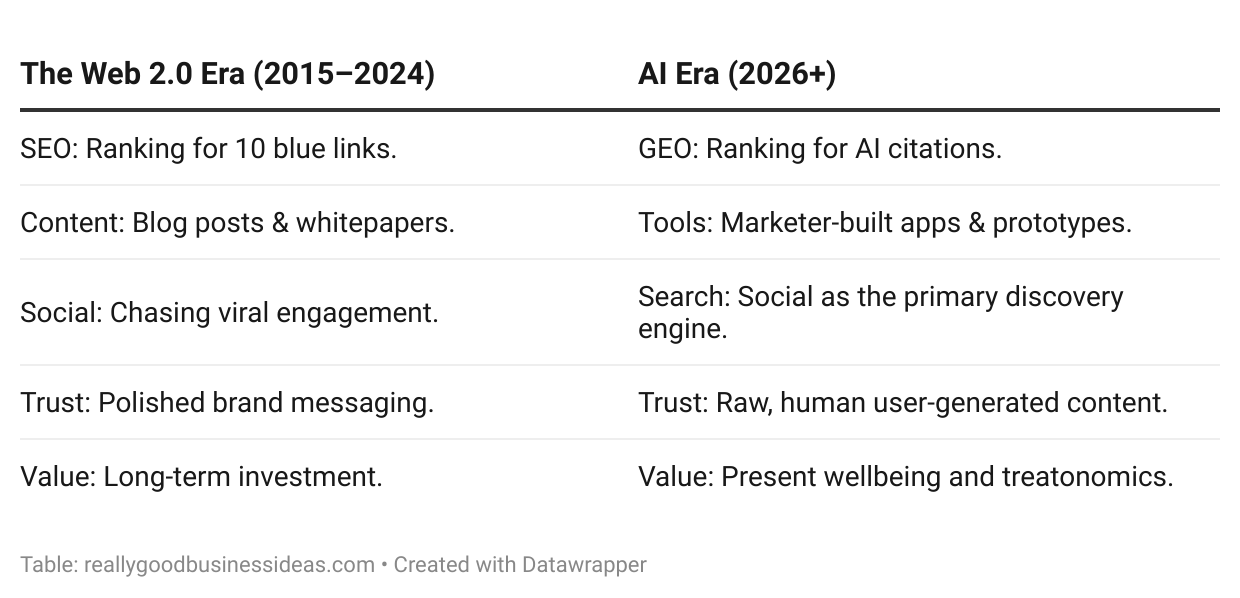
Click here to open the table in a new tab.
The End of Average
If there is one takeaway for 2026, it is that the comfortable middle ground is gone.
For the last decade, you could succeed by being “kind of” technical and “kind of” personal. That era is over. The future belongs to brands that can inhabit the extremes: using AI to achieve ruthless efficiency in the back office, while doubling down on raw, unscalable humanity in the front office.
The winning formula for 2026 is a paradox: Use machines to buy back the time you need to be human. The tools have never been better, but the premium on human connection has never been higher. The marketers who master this split won’t just survive the AI era, they will define it.
To endless possibilities and a great year,
Casandra

I've thought it before....Every 25-year-old who wants to create a business with any digital element needs to be one of your paid subscribers.
Thanks for giving me some hope for the future.