


Search underwent a dramatic shift in 2025, and with it, the way brands are discovered online: More people began using LLMs like Google’s AI Overviews, ChatGPT, and Perplexity to answer questions and find information.
50% of Google searches already have AI summaries, and this is expected to rise to more than 75% by 2028.1
Half of consumers now intentionally seek out AI-powered search engines, with a majority saying it’s the top digital source they use to make buying decisions.2
Use of AI-powered search spans all ages, including a majority of older generations already adopting it.3
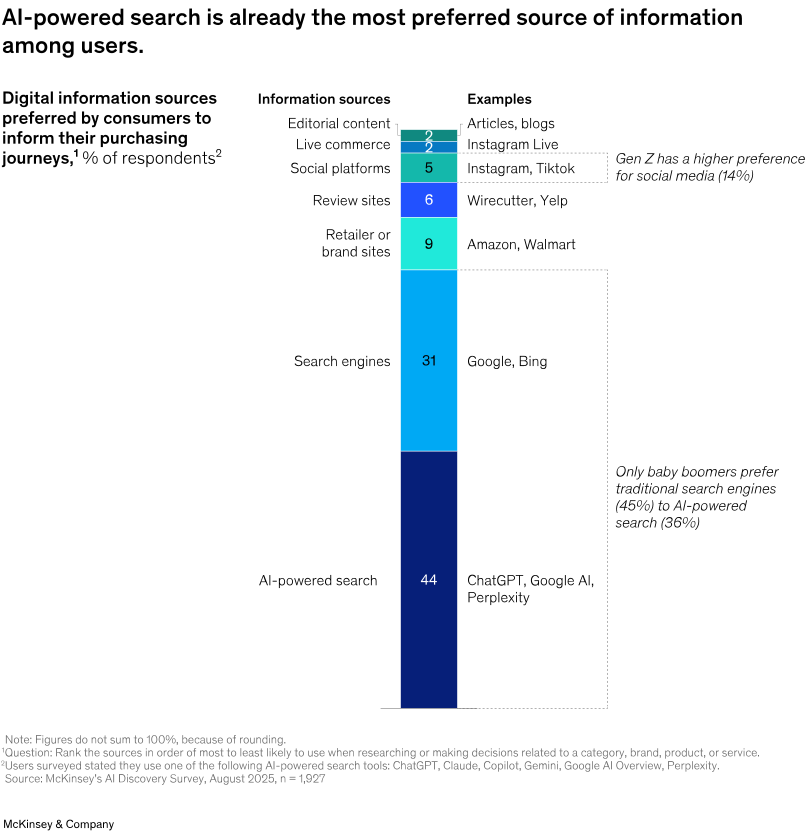
It’s no wonder McKinsey has declared AI search to be the new front door of the Internet!4
Search engine optimization (SEO) has given way to generative engine optimization (GEO) as the tactics for getting discovered in search have evolved.

One such evolution? GEO content strategy places an even greater emphasis on content structure (although it was always important for SEO, too). This is because visibility in AI search increasingly depends on whether those systems can clearly understand and cite your work.
Table of Contents
How to Write Inverted Pyramid Snippets AI Will Cite (Step-by-Step)
Before/After: What Inverted Pyramid Snippets Look Like in Practice
What Is the Inverted Pyramid (and Why Does It Matter Now)?
The inverted pyramid is a writing structure where you lead each section with the most important information: a clear, direct, 2–3 sentence answer to the core question. This format makes your content easy for AI engines to parse, extract, and cite because the key idea appears immediately under a natural-language subheading.
The inverted pyramid isn’t a new invention; it’s actually a 100-year-old journalism framework.5
Reporters used it because, during the telegraph era, transmissions often got cut off. If you didn’t send the most essential facts first, your story literally didn’t make it to the newspaper. So journalists learned to put the “lede” (the key info) right at the top.
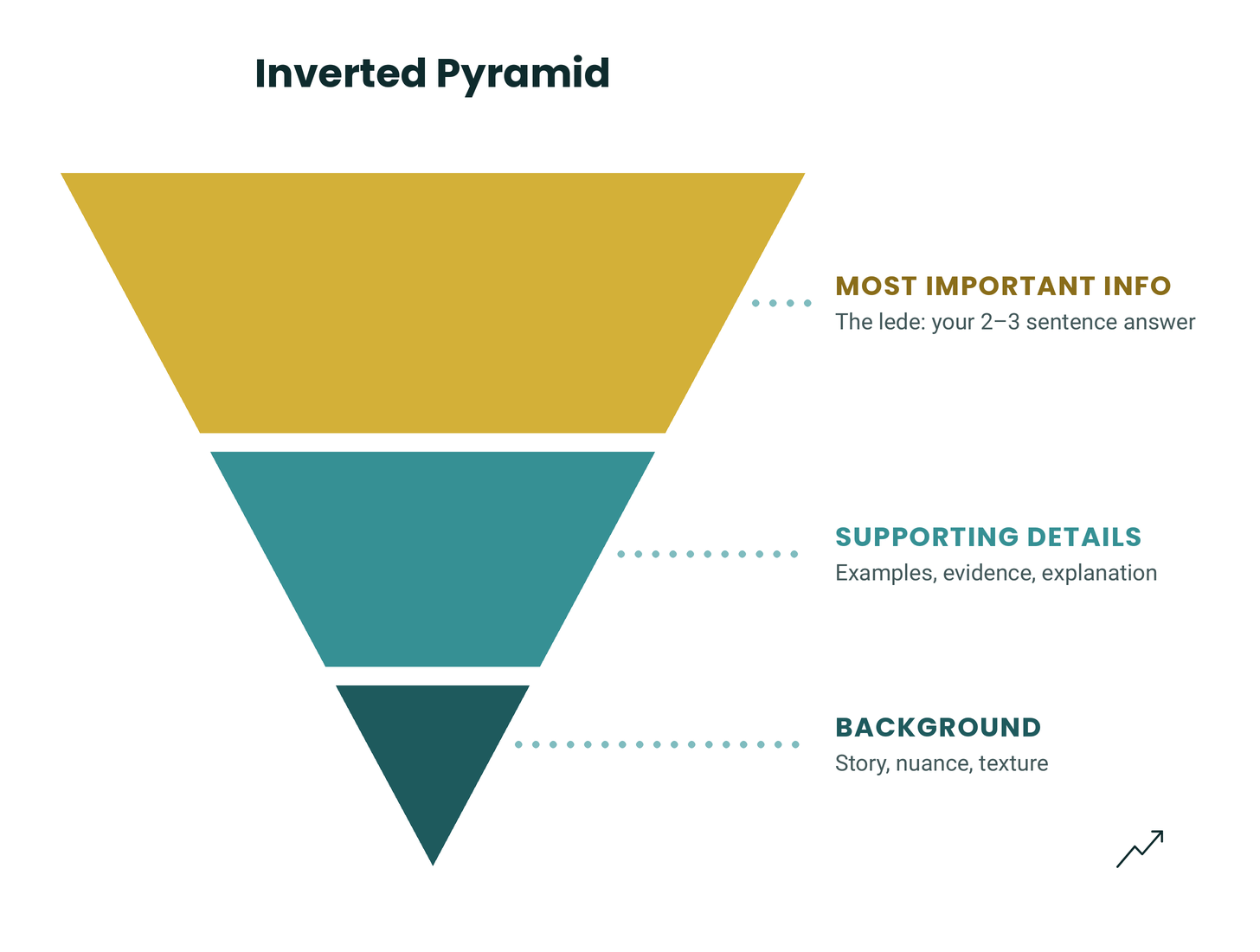
That structure survived because it was efficient. Editors, readers, and newsrooms all loved it. But then digital media arrived, and everything flipped. Display ad revenue, powered by pageviews and time-on-page, became the business model, so writers moved to hooks, storytelling intros, personal anecdotes, and a slow build toward the point. Not because it conveyed the information more clearly, but because it kept people on the page longer.
AI changed that (again). Large language models read like telegraphs: they scan from the top down, searching for a clean, high-confidence answer to a specific query. If they don’t find it quickly, they move on.
So the inverted pyramid, once created to prevent telegraph losses, suddenly becomes one of the best tools for:
Making your content machine-readable.
Increasing your chance of being cited.
Improving the clarity of your explanations.
Giving AI a clean unit of meaning to extract.
It’s a 100-year-old framework that, by accident, became perfect for the AI era.
Why AI Loves The Inverted Pyramid Structure
AI answer engines aren’t evaluating your writing for style, voice, or narrative tension. They’re evaluating it for extractability: how quickly and confidently they can locate the exact answer to a user’s question. The inverted pyramid makes that straightforward.
Here’s why LLMs prefer it:
1. It reduces ambiguity. A 2–3 sentence definition placed directly under a question header tells the model, “This is the answer.”
2. It matches how AI organizes information. Models break text into small semantic chunks. A tight, self-contained paragraph is a perfect unit: easy to interpret and easy to cite.
3. High-information density. AI prefers efficient paragraphs. Vague, fluffy writing gets ignored because it introduces ambiguity and lowers the model’s confidence in information quality.
4. A complete unit of meaning. The best snippets are stand-alone paragraphs that don’t require the sentences before or after them to make sense. If the model can copy it with minimal editing, it’s more likely to be cited.
5. It mirrors user intent. If your header mirrors the way a human would phrase the question, the model has a much easier time matching your answer to the query. For example, “What is the inverted pyramid?” or “How does GEO work?”
6. It aligns with how LLMs were trained. Most high-quality training data (encyclopedias, glossaries, FAQs, academic definitions) follow an answer-first approach. So models already “expect” important information to appear at the top of a section.
7. It gives AI a clear, quotable block. LLMs prefer grabbing a paragraph they don’t have to edit much. A clean 2–3 sentence snippet is exactly the kind of block that can be easily integrated into a synthesized answer.
8. Low risk of error. AI chooses sources that reduce uncertainty. A crisp definition, a clear mechanism, or one specific detail increases confidence that you’re authoritative and, therefore, safer to cite.
Once you understand what AI is looking for, the question becomes: how do you give it a snippet it can’t resist? The 2–3 sentence template makes this easy.
The 2–3 Sentence Template (Steal This)
If AI wants clarity served in a single, self-contained unit, the easiest way to deliver it is with a simple structure you can use in every article, guide, or resource you publish. Think of this as your “AI-ready paragraph,” something the model can quickly and easily cite.
Here’s the template:
Question/Topic as a Subheading
[Direct answer or definition]. [One sentence explaining how it works or why it matters]. [Optional sentence adding a specific detail, nuance, or proprietary insight that strengthens your authority].
Two to three sentences: One complete, quotable idea.
This structure works for anything: tactical definitions, strategic frameworks, industry explanations, audience terminology, or even internal concepts you’ve coined.
Here’s an example from earlier in this article:
What Is the Inverted Pyramid (and Why It Matters Now)
The inverted pyramid is a writing structure where you lead each section with the most important information: a clear, direct 2–3 sentence answer to the core question. This format makes your content easy for AI engines to parse, extract, and cite because the key idea appears immediately under a natural-language subheading.
What matters most isn’t the exact phrasing; it’s the density, clarity, and completeness of the answer. When you nail those three things, you create a unit of information that AI engines can trust and use.
How to Write Inverted Pyramid Snippets AI Will Cite (Step-by-Step)
Writing a 2–3 sentence snippet is simple, but it’s even easier when you follow a consistent process. Use this as your repeatable workflow: something you can run every time you draft a new article, guide, or resource.
1. Turn the idea into a natural-language question.
Before you write the snippet, write the header. Your header should mirror how a real human would ask the question, and yes, this is where keyword research helps. You don’t need a full SEO deep dive, but you do need to know how people actually phrase the query you’re answering.
Turn those into clear, question-style headers:
What is the inverted pyramid?
How does GEO work?
Why does entity authority matter?
How do you grow a Substack audience?
This immediately tells both your reader and the model what the answer needs to deliver. Without this, the rest of the snippet has to work much harder.
2. Write a direct, 2–3 sentence answer.
Imagine you’re sending a voice note to a friend, and you only have 10 seconds to explain something clearly. If you’re not sure whether or not you’ve nailed it, read it out loud. You’ll likely notice right away if you’re taking too long to explain.
3. Strip away anything that doesn’t directly answer the question.
Most snippets start out too long and winding. That’s ok for a first draft, but make sure you give it a good edit to remove:
Qualifiers like “I think,” “generally,” “perhaps,” “it seems that,” or “it might be said.”
Scene-setting like “Before we dive in,” “When I woke up this morning,” or describing the context before getting to the point.
Metaphors like “The North Star of your strategy,” “The engine under the hood,” or “Think of your brand like a garden.”
Backstory like “I’ve been doing this for 15 years,” “The reason I started this project,” or the history of how a concept evolved.
Personality flourishes like sarcasm, inside jokes, slang, or rhetorical asides such as “Cool, right?” and “(obviously!).”
Anything that forces the reader (or the model) to wait for the point like long introductory hooks, table-setting sentences, or "In this article, I will show you..."
Remember: you’re not deleting those elements forever. You’re simply moving them below the snippet, where they can expand, illustrate, and enrich the idea.
Think of the snippet as the answer: clean, extractable, quotable. Everything that follows becomes the explanation: the story, the nuance, the examples, and the texture of your voice.
4. Add one high-information detail that only you could add.
This is the secret ingredient. AI prefers content that offers something specific, uncommon, concrete, original, or phrased in a unique, recognizable way.
You can boost your authority by showing the model that you’re not repeating generic internet wisdom, you’re adding something new and non-derivative.
Examples of the kind of detail that works:
A proprietary term (e.g., Friend of a Friend Audience Growth Framework).
A small data point or benchmark.
A unique phrasing or analogy.
A nuance most people miss.
A pattern you’ve observed from your own work.
These details tell the model that you’re an authority on the topic and you actually know what you’re talking about.
5. Make sure the paragraph stands alone.
A good snippet should survive outside the article like a well-written text message: clear, self-contained, and impossible to misunderstand.
To test this, copy your snippet into a blank document and read it without any of the surrounding context.
Does it still make sense?
Does it answer the question directly?
Would someone who’s never heard of you understand what you’re saying?
If the answer is yes, you’re done. If not, trim, tighten, or clarify until the paragraph can stand on its own two feet. The goal is a little block of meaning that AI can use without needing anything else to support it.
6. Add in story, examples, and nuance after the snippet.
Once you’ve got a strong snippet, then you can stretch out and be a human again.
This is where the hooks, anecdotes, insights, and realtalk belong. This is where your personality lives, and you can slow down, zoom in, or wander a little, because now you’re writing for a human reader, not a machine.
Thinking of it like baking a cake:
Snippet: The icing is the sweet, immediate draw on top.
Everything after: The cake layers provide the actual substance and flavor.
This order isn’t about limiting you. It’s about creating a structure where both of your audiences, human readers and the machines that help those readers find you, get exactly what they need. And frankly, these clear, upfront definitions aren’t just for AI. They make your writing easier for everyone to follow. Readers appreciate knowing exactly what you’re talking about before you take them deeper.
Before/After: What Inverted Pyramid Snippets Look Like in Practice
It’s hard to see how big the shift is until you compare the two structures side by side. Here are a few real-world examples that show exactly how the inverted pyramid plus a 2–3 sentence snippet changes the clarity of your writing and your chances of being cited.
Example 1: The Inverted Pyramid
Before (Typical Narrative Intro)
A lot of people talk about getting to the point, but it’s surprisingly hard to do in practice. Most writing wanders, eases in, or starts with a metaphor or anecdote. The inverted pyramid tries to fix this by putting the most important part first, but let’s talk about what that actually means…
LLMs will never reference this because the definition is too buried.
After (Clear Snippet Under a Question Header)
What is the inverted pyramid?
The inverted pyramid is a writing structure where you place the most important information at the top of a section, usually as a short, direct, 2–3 sentence answer. It gives readers immediate clarity and helps AI answer engines extract and cite your content without needing additional context.
LLMs immediately know what this is and can cite it cleanly.
Example 2: GEO (Answer Engine Optimization)
Before
GEO is becoming a more important part of content strategy as AI tools continue to grow, but many creators still don’t understand why. It’s not just about SEO, and it’s not just about formatting…
The answer is nowhere near the top.
After
What is GEO?
GEO (generative engine optimization) is the practice of structuring your content so AI models can easily understand, extract, and cite it in synthesized answers. It relies on answer-first snippets, strong entity signals, and high-information content that increases model confidence and reduces ambiguity.
Immediately provides a succinct definition.
Example 3: Entity Authority
Before
Entity authority is becoming one of the most important parts of modern SEO and GEO. The problem is, most explanations of entity authority are either too technical or too vague…
Doesn’t really say anything.
After
What is entity authority?
Entity authority is the degree to which AI models and search engines recognize you (or your brand) as a trusted source on a specific topic. It’s built through consistent content, brand mentions, clear definitions, and unique insights that reinforce your expertise across the web.
LLMs love this kind of snippet.
These “after” versions give AI exactly what it’s scanning for:
A natural-language header.
A clean, standalone, 2–3 sentence word definition.
High information density.
One tight unit that can be easily cited.
Remember, human readers like this, too! It gives us a clear framework to orient ourselves before going deeper into the concept.
The Inverted Pyramid Is How You Get Cited
The inverted pyramid isn’t new. It’s a century-old structure designed to help people get the information they need as quickly as possible. We just forgot about it when digital media trained us to chase scroll depth and time-on-page.
Now, AI has changed the incentives again: The clearest answer wins, not the longest buildup.
A crisp 2–3 sentence snippet under a descriptive header is one of the easiest ways to improve your visibility in AI search. It helps LLMs understand you faster, boosts your chances of being cited, and also makes your writing easier for actual humans to follow.
The goal is to order your ideas in a way that works for both audiences:
Humans get the story and the texture; AI gets the clean definition it needs to include your work in the answers people see.
AI gets the clean, extractable definition it needs to include your work in the answers people see.
And when you get both working together, and the story and the structure line up, your writing becomes more discoverable and more likely to show up in the places people are searching now.
As the web shifts from links to answers, inverted pyramids become your competitive advantage.
To endless possibilities,
Casandra
I love how the principles of good storytelling are timeless.
Wow, I love how clear your steps are to easily adapt content to GEO structure. Thank you!